Refrigerator Leaking Water: Where It Comes From
Refrigerators produce water on purpose, all the time. Frost melts during each defrost cycle and drains to a pan underneath where it evaporates. A leak means that water found a different route.
Quick answer
Water inside the refrigerator, typically under the crisper drawers, almost always means a blocked defrost drain. Water on the floor points instead at the water supply line, the ice maker connection, or a drain pan that is overflowing or cracked. Where the water appears is the most useful clue you have, so note that before anything else.
Narrow down the cause
Answer a few questions about what your refrigerator is actually doing. It takes about a minute and nothing is saved.
What is your refrigerator doing?
Loading the questions…
The questions could not be loaded. The written guide below covers the same ground.
Start With These Quick Checks
- Note exactly where the water is. Inside under the drawers, inside at the bottom of the freezer, or on the floor. These are three different problems.
- Check the water supply line behind the fridge. Pull the unit out and look at the connection and along the tubing for drips, corrosion or a damp patch on the wall.
- Look for ice at the bottom of the freezer. A sheet of ice under the freezer floor is the classic sign of a blocked defrost drain.
- Check the door seals. A door that does not seal lets in humid air, which condenses and drips. The dollar bill test works here too.
- Check the fridge is level and tilted very slightly back. This helps doors close and helps interior water drain the way it was designed to.
- Look at the drain pan underneath. Pull the fridge out and check the shallow pan near the compressor. It should have some water in it. Cracked or dislodged pans leak onto the floor.
- Check for a recently replaced water filter. Filters that are not seated properly are a common cause of a sudden leak.
Most Likely Causes
| Cause | What You May Notice | Difficulty |
|---|---|---|
| Blocked defrost drain | Water under crisper drawers, ice sheet in the freezer floor | Moderate |
| Water supply line leak | Water on the floor behind or beside the fridge, damp wall | Moderate |
| Loose or faulty water filter | Leak started right after a filter change | Easy |
| Ice maker line or fill fault | Water or ice at the back of the freezer, oversized ice pieces | Moderate |
| Poor door seal | Condensation on interior walls, frost near the door, damp shelves | Easy |
| Cracked or displaced drain pan | Water on the floor underneath, no interior leak | Moderate |
| Fridge not level | Water pooling on one side, doors not closing on their own | Easy |
Where Refrigerator Leaks Come From
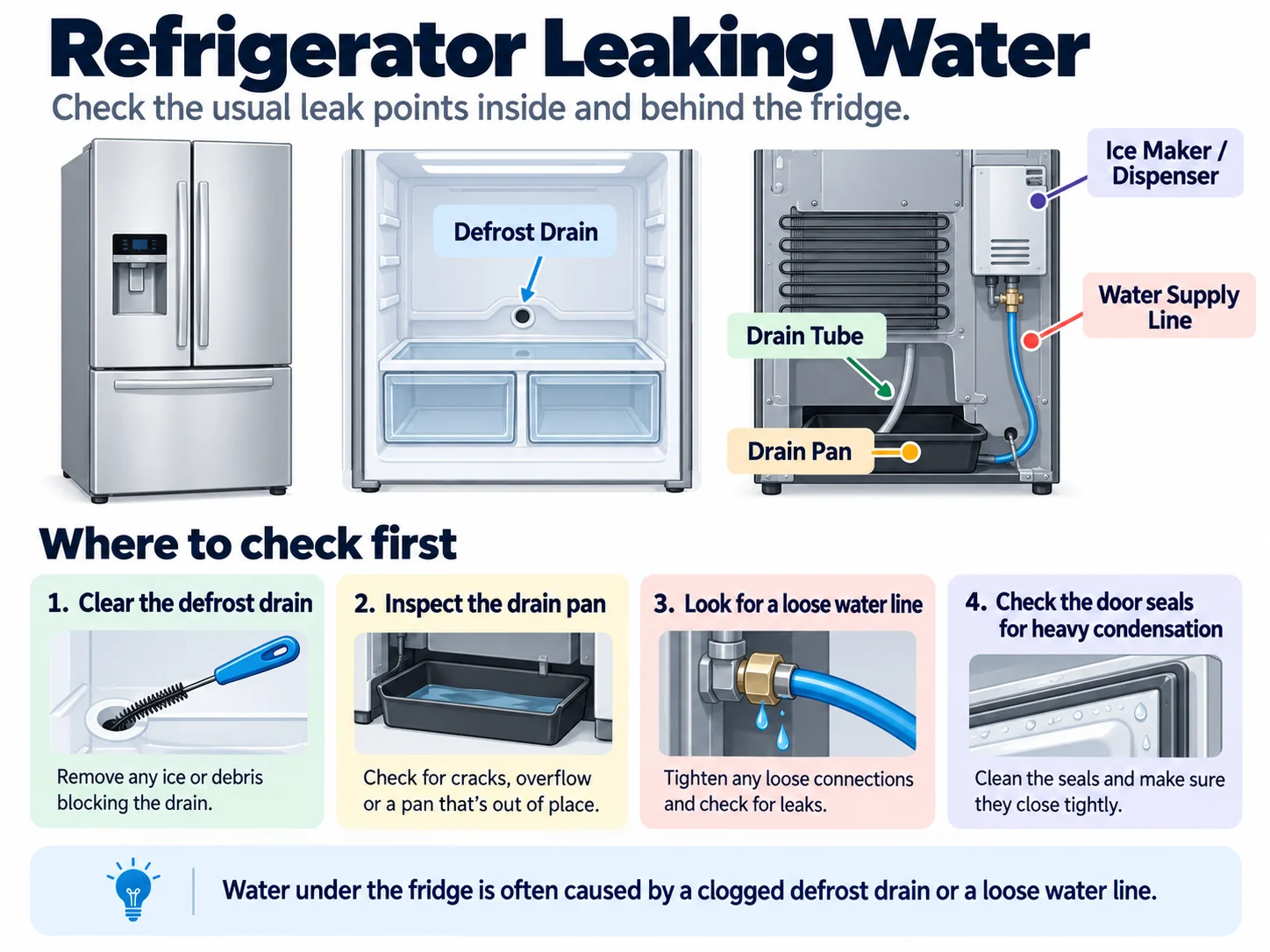
1. Blocked Defrost Drain
This causes the majority of interior leaks, and the mechanism is simple. During each defrost cycle, frost on the evaporator coil melts. That water runs into a trough and down a small drain tube to the pan below, where it evaporates.
If that tube blocks, the water has to go somewhere else. It backs up, freezes into a sheet at the bottom of the freezer, and eventually finds its way forward into the fresh food section, where it appears under the crisper drawers.
What you may notice: a thin layer of ice under the freezer floor, water under the drawers, and often both at once.
How to check: empty the freezer and look at its floor. A visible ice sheet is the confirmation. The drain opening is usually at the back of the freezer compartment, low down, sometimes behind a panel.
What to do next: clearing the drain is often a homeowner job. Unplug the fridge, let the ice melt, and flush the drain gently with warm water using a turkey baster. Do not force wire or anything sharp into the tube; it is easy to damage the trough or puncture tubing near the coil.
What it means if it comes back: repeat blockages sometimes indicate a design issue with the drain or a defrost fault upstream. That is worth a technician’s opinion.
2. Water Supply Line
Refrigerators with an ice maker or a water dispenser have a supply line running to them, usually a small-diameter plastic or copper tube from a valve under the sink or behind the fridge.
What you may notice: water on the floor rather than inside, often at the back or one side, and sometimes a damp patch on the wall or baseboard.
How to check: pull the fridge out carefully and inspect the whole run: the shutoff valve, the compression fittings at each end, and the tubing itself. Kinks from pushing the fridge back too far are common.
What to do next: if you find the leak at a fitting, turn off the supply valve first. Tightening a compression fitting slightly can help, but overtightening makes it worse. If the tubing itself is damaged, it needs replacing.
3. Water Filter
Filters are a frequent source of sudden leaks because they are the one part in the water path that owners change themselves.
What you may notice: a leak that started within a day or two of changing the filter.
How to check: confirm the filter is fully seated and locked in the correct position. Check that the old filter’s O-ring did not stay behind in the housing, which is a very common cause and produces an immediate leak.
What to do next: reseat it, and if it still leaks, try a different filter. A poorly made aftermarket filter that does not match the housing dimensions will leak no matter how well you fit it.
4. Door Seals and Condensation
If humid room air gets in continuously, it condenses on cold surfaces inside and runs down.
What you may notice: water on interior walls and shelves rather than pooled in one place, frost near the door opening, and a fridge that runs more than it used to.
How to check: the dollar bill test around the whole door, plus a look for tears and flattened sections. Clean sticky residue off both the gasket and the cabinet.
What to do next: in very humid weather some condensation is normal, especially if the doors are opened often. Persistent water with a seal that fails the bill test means the gasket needs attention.
5. Drain Pan Underneath
The pan collects defrost water and lets it evaporate using heat from the compressor. If it cracks, gets knocked out of position when the fridge is moved, or fills faster than it can evaporate, water ends up on the floor.
How to check: unplug the fridge and pull it out. The pan is usually a shallow tray near the compressor at the back.
What to do next: reseating a displaced pan is straightforward. A cracked one needs replacing. A pan that is consistently overflowing suggests too much defrost water, which points back at the defrost system or a door seal.
What Your Symptoms Mean
- Water under the crisper drawers.Defrost drain, almost certainly.
- Sheet of ice on the freezer floor.Same cause, seen from the other side.
- Water on the floor at the back.Supply line, ice maker line, or drain pan.
- Water on the floor at the front.Often interior water that has run forward, or a door seal issue.
- Leak started right after a filter change.The filter or a stuck O-ring.
- Water on interior walls rather than pooled.Condensation, usually a door seal.
- Leaking and not cooling properly.Check cooling first; see a refrigerator that is not cooling.
When to Call a Technician
Do yourself: identifying where the water is, checking and reseating the filter, inspecting the supply line, the dollar bill test on the seals, levelling, and gently flushing an accessible defrost drain.
Call a technician when the defrost drain blocks repeatedly, when the drain is not reachable without dismantling the freezer, when you cannot locate the source at all, or when the leak comes with a cooling problem. Turn off the water supply valve in the meantime if the leak is on the water line, and keep water away from the outlet the fridge is plugged into.