Refrigerator Not Cooling: Airflow, Defrost and Coils
Most refrigerators cool one thing directly, the freezer, and then blow cold air into the fresh food section. Knowing that makes a warm fridge much easier to diagnose.
Quick answer
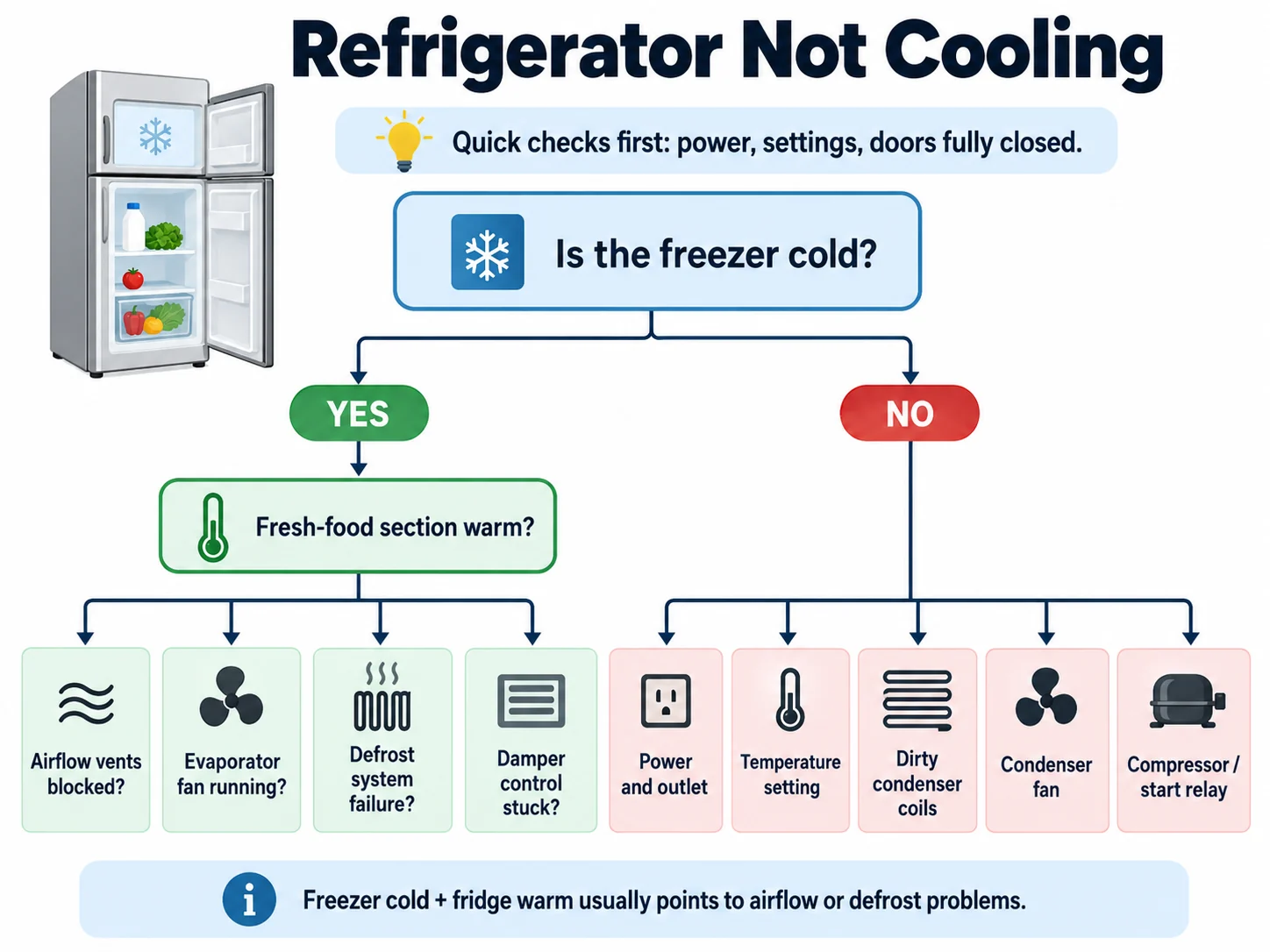
If the freezer is cold but the refrigerator section is warm, the problem is almost always airflow: the fridge is cooled by air blown from the freezer, so a blocked vent, a stopped evaporator fan or a frosted-over evaporator coil starves it. If both compartments are warm, look at dirty condenser coils, a door that is not sealing, or a compressor problem. Check whether the freezer is still cold first, because that single fact splits the diagnosis.
Narrow down the cause
Answer a few questions about what your refrigerator is actually doing. It takes about a minute and nothing is saved.
What is your refrigerator doing?
Loading the questions…
The questions could not be loaded. The written guide below covers the same ground.
Start With These Quick Checks
- Is the freezer still cold? This is the most useful question. Cold freezer with a warm fridge means airflow. Both warm means something more fundamental.
- Check the temperature settings. They get knocked, and on models with a control panel they can be changed accidentally. A common starting point is around 37°F for the fridge and 0°F for the freezer.
- Look for anything blocking the vents. The vents between the freezer and fridge sections need clear space. A tall box or a packed shelf pressed against the back wall will stop the airflow.
- Listen for the evaporator fan. With the freezer door open, press the door switch and you should usually hear a fan running inside the freezer. Silence there is a strong clue.
- Check the door seals. Close the door on a dollar bill and pull it out. Firm resistance is good. If it slides out easily, the seal is not doing its job at that point.
- Pull the fridge out and look at the condenser coils. On many models they are underneath at the back or behind a lower grille. Thick dust or pet hair is a very common cause.
- Check it is not simply overloaded or recently restocked. A big warm grocery load raises the temperature for several hours, which is normal.
Quick Diagnostic Flowchart
Most Likely Causes
| Cause | What You May Notice | Difficulty |
|---|---|---|
| Blocked air vents | Freezer cold, fridge warm, food packed against the back wall | Easy |
| Dirty condenser coils | Both sections warm, compressor running constantly, warm at the back | Easy |
| Door not sealing | Condensation, frost near the door, motor running more than usual | Easy |
| Failed evaporator fan | Freezer cold, fridge warm, no fan sound from the freezer | Moderate |
| Frosted-over evaporator coil | Cooling declines over days, ice visible behind the freezer back panel | Technician recommended |
| Defrost system fault | Repeats every few weeks: cools fine, then declines again | Technician recommended |
| Compressor or sealed system fault | Both sections warm, no cooling at all, sometimes silent | Technician recommended |
1. Blocked Airflow Inside
In most modern refrigerators only one set of coils actually gets cold. The freezer is cooled directly, and a fan pushes some of that cold air through a duct into the fresh food compartment.
That design explains the single most common symptom: a freezer that is still rock solid while the fridge climbs into the 50s. The cooling is working; the cold air is not arriving.
How to check: empty the shelves nearest the back wall and find the vents. Make sure nothing is pressed against them. Also check the freezer side, where a large frozen item can block the outlet.
What it means: if clearing the vents fixes it within a few hours, you are done. If not, the fan or the coil behind that wall is the next suspect.
2. Dirty Condenser Coils
The condenser gets rid of the heat pulled out of the food. It relies on air moving across it, and it sits low down where dust, lint and pet hair collect.
What you may notice: both compartments running warm, the compressor running almost continuously, and noticeable heat at the back or underneath.
How to check: unplug the refrigerator, then look at the coils behind the lower grille or at the back. A visible mat of dust is your answer.
What to do next: vacuum them with a brush attachment and a coil brush if you have one. This is genuinely worth doing once or twice a year, especially with pets in the house. It is one of the few maintenance jobs that measurably reduces running cost.
3. Door Seals
A seal that no longer closes properly lets warm, humid room air in continuously. The refrigerator responds by running more, and in humid weather that also causes frost buildup.
How to check: the dollar bill test, done at several points around the door, including the hinge side and the corners. Also look for tears, flattened sections, and gaps where the gasket has pulled away.
What to do next: clean the gasket and the frame first, because sticky residue is a common cause of poor sealing. Check that the fridge is level and tilted very slightly back so doors close on their own.
4. Evaporator Fan
The evaporator fan moves air across the cold coil and into both compartments. If it stops, the freezer often stays cold because the coil is right there, while the fridge slowly warms up.
What you may notice: silence from inside the freezer where you used to hear a fan, and a fridge that is warm while the freezer is fine. Some people notice the fridge cooling better when the doors have been opened repeatedly, which is a misleading coincidence.
How to check: open the freezer and press the door switch by hand. On most models the fan should run. Note that door switches turn fans off, so this test needs the switch held in.
What to do next: replacing an evaporator fan means removing the freezer back panel and usually defrosting the compartment. A technician is the sensible route unless you are confident.
5. Frost on the Evaporator Coil
Behind the back panel of the freezer sits the evaporator coil. A defrost system melts frost from it periodically. When that system fails, frost builds up until air can no longer pass through, and cooling falls off progressively.
What you may notice: a decline over days rather than a sudden failure, sometimes with a repeating pattern where the fridge recovers after being turned off for a day and then gets worse again. That “fixed by defrosting it overnight, then broken again in a week” pattern is a strong indicator.
How to check: if you can see the back panel of the freezer, heavy frost or a solid sheet of ice is the sign. Do not chip at it with anything sharp; the coil and its tubing are easily punctured.
What to do next: a defrost fault is a diagnosis job. There are several components involved, and guessing is expensive.
6. Compressor and Sealed System
If both compartments are warm, the coils are clean, and the compressor is either silent or running without producing any cold, the problem may be in the sealed refrigeration system.
What it means: this is not a homeowner repair under any circumstances. Sealed systems contain refrigerant under pressure and require certified equipment and handling. Depending on the age of the appliance, this is also the point where replacement often makes more sense than repair.
What Your Symptoms Mean
- Freezer cold, fridge warm.Airflow: blocked vents, evaporator fan, or a frosted coil.
- Both warm, motor running constantly.Condenser coils, door seals, or the sealed system.
- Both warm, no sound at all.Power, control board, or compressor.
- Cools well, then gets worse over several days, repeatedly.Classic defrost system pattern.
- Warm only after a big grocery shop.Normal. Give it several hours.
- Ice building up inside the freezer or on the back wall.Defrost, or a door seal letting humid air in.
- Fridge is warm and there is water under the crisper drawers.See a refrigerator leaking water.
When to Call a Technician
Do yourself: settings, vent clearance, condenser coils, door seals, and levelling.
Call a technician when the freezer is cold and the fridge stays warm after clearing the vents, when you can see heavy frost behind the freezer panel, when cooling declines repeatedly on a cycle of days or weeks, or when there is no cooling at all. Anything involving refrigerant is legally and practically a certified technician’s work.
If the refrigerator has been warm for several hours, deal with the food first. Perishables that have been above 40°F for more than two hours are not worth the risk.
Brand-specific guides
The checks above apply to any refrigerator. These guides cover the same problem on specific brands.