Washer Won't Fill With Water: What to Check
A no-fill problem can look electronic even when the cause is simply no water reaching the machine. Separate a supply problem from a control problem before replacing anything.
Quick answer
If a washer will not fill, start outside the machine: make sure the water faucets are open, the inlet hoses are not kinked, and the door or lid is fully closed. Then try another cycle and listen for any attempt to bring water in. If the washer has water available but never begins filling, the inlet-control or safety system may need model-specific diagnosis.
Narrow down the cause
Answer a few questions about what your washer is actually doing. It takes about a minute and nothing is saved.
What is your washer doing?
Loading the questions…
The questions could not be loaded. The written guide below covers the same ground.
Start With These Quick Checks
- Confirm both water faucets are open. Do not assume they were left open after moving, cleaning or service.
- Inspect the inlet hoses for kinks. A washer pushed back too far can pinch a hose.
- Close the door or lid firmly. Many machines will not proceed normally if they do not detect a secure closure.
- Try a different wash cycle. This helps separate one unusual setting from a general no-fill condition.
- Look for a delay-start setting. The washer may be waiting rather than failing.
- Listen when the cycle begins. Silence, a click, or a brief hum are different clues.
How Water Reaches the Tub
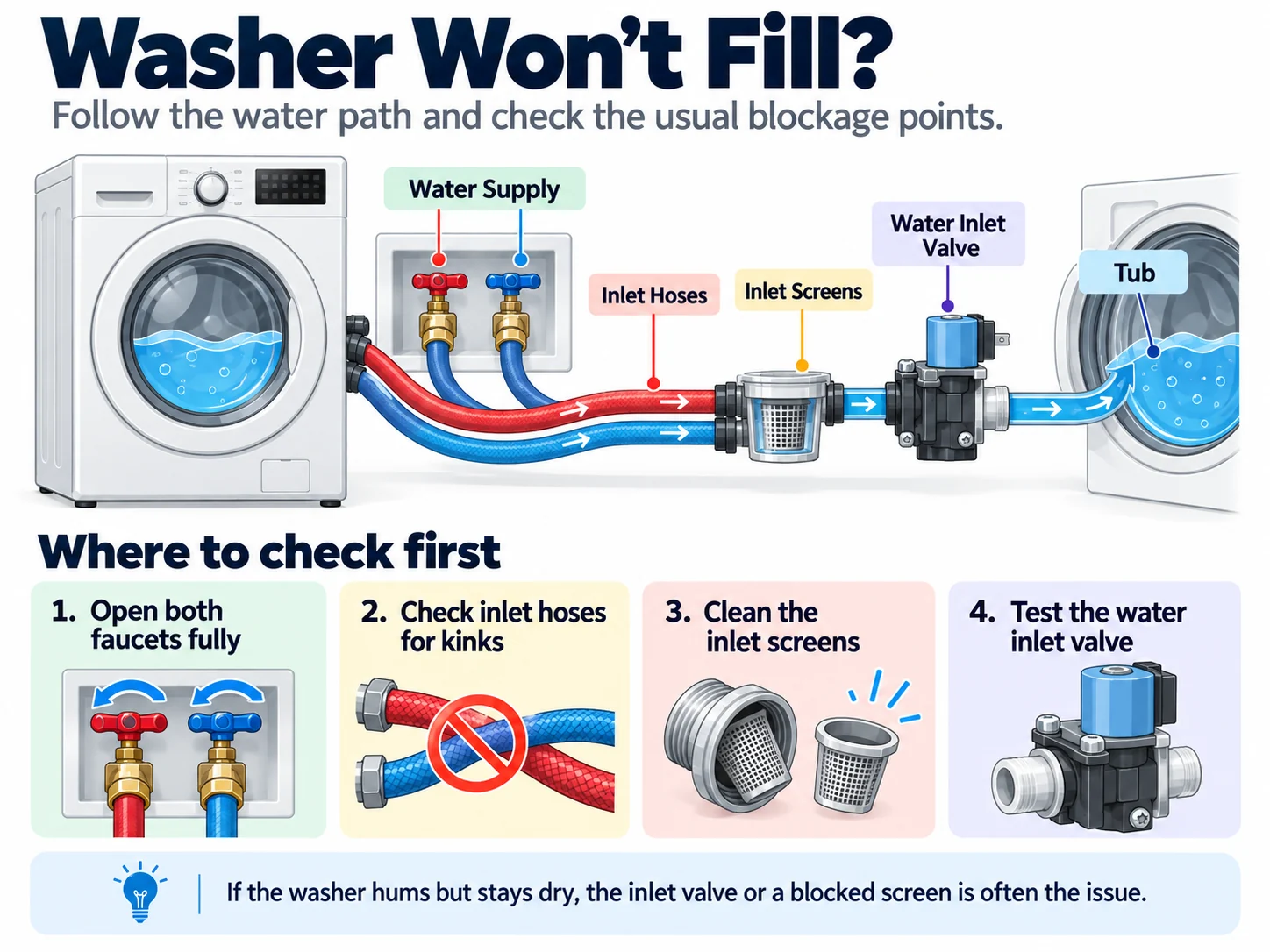
Most Likely Causes
| Cause | What You May Notice | Difficulty |
|---|---|---|
| Water faucet closed | No water sound, often after moving or service | Easy |
| Inlet hose kinked | Little or no flow, hose visibly pinched | Easy |
| Door or lid not recognized as closed | Cycle will not advance normally | Easy |
| Cycle or delay setting | Machine waits but shows normal controls | Easy |
| Inlet screen or supply restriction | Fill is very slow rather than completely absent | Moderate |
| Inlet valve or control fault | Water supply is good but washer never fills | Technician recommended |
1. The Water Supply Is Turned Off
The simplest no-fill cause is no available water at the washer.
How to check: confirm the hot and cold supply faucets are open. If one was recently closed for service, this is especially likely.
What it means: if water begins entering as soon as the supply is restored, no internal diagnosis is needed.
Do not force a stuck household shutoff valve. A leaking or seized valve is a plumbing problem.
2. An Inlet Hose Is Kinked
The washer may have normal household water pressure but still receive little or no water if a hose is folded behind the cabinet.
How to check: turn the washer off and inspect the visible hose path. Make sure the machine is not crushing a hose against the wall.
What it means: a kink often causes slow filling rather than complete silence, so note whether some water is entering.
3. The Door or Lid Is Not Being Accepted as Closed
Washers use a door or lid safety system as part of their operating sequence.
How to check: remove any clothing trapped near the closure, close it normally and try again. Do not slam the lid or bypass a switch.
What it means: if the machine behaves differently when the door or lid is closed correctly, the closure system deserves attention.
4. The Selected Cycle Is Delaying Fill
Some cycles pause, sense the load or wait before adding water.
How to check: try a normal everyday cycle and cancel any delay-start option. Give the machine enough time to complete its normal initial checks.
If the washer appears to stay in its initial sensing stage rather than progressing, compare the stuck-on-sensing guide.
5. Water Is Entering Too Slowly
A partially restricted supply can make a washer appear stuck because the expected water level takes too long to arrive.
What you may notice: a weak trickle, one temperature fills better than the other, or the machine eventually fills after a long wait.
What to do next: inspect the hoses and household supply. Cleaning inlet screens is model-specific because access and handling instructions vary, so follow the owner’s manual if you go beyond the external hoses.
6. The Inlet or Control System Is Not Opening the Water Path
If household water is available, hoses are clear, the door or lid is accepted and the washer still never attempts to fill, the fault may be inside the machine.
What you may notice: normal display and cycle selection, but no water enters on multiple cycles.
What it means: the exact cause could involve the inlet valve, wiring, pressure sensing or control logic. Those cannot be separated reliably from the symptom alone.
What Your Symptoms Mean
- No water sound at all after moving the washer.Check faucets and kinked hoses first.
- Only a weak trickle enters.Think restricted supply rather than a completely dead washer.
- Washer waits with a door or lid message.Resolve the closure issue before pursuing water parts.
- Normal cycle waits but another cycle fills.Settings or cycle behavior are useful clues.
- Washer sits on sensing and never fills.Compare the stuck-on-sensing guide.
- Water supply is definitely good but no cycle fills.Internal inlet or control diagnosis becomes more likely.
When to Call a Technician
Do yourself: check water faucets, hose routing, door or lid closure, delay settings and another normal cycle.
Call a technician when the external water supply is good but the washer does not admit water on any cycle, or when diagnosis requires opening the machine or testing electrical controls. Call a plumber if the household shutoff valve or water supply itself is the problem.