Washer Won't Drain: Finding the Blockage
The cycle finishes, the door stays locked, and there is water sitting in the drum. Almost every time, something is physically in the way rather than broken.
Quick answer
Standing water at the end of a cycle nearly always means a blockage rather than a failed part. The usual culprits are the drain pump filter, a kinked or clogged drain hose, or something small like a coin or a sock caught in the pump. Check the filter first: on most front-load washers it is behind a small access panel at the bottom front, and it is the single most common cause.
Narrow down the cause
Answer a few questions about what your washer is actually doing. It takes about a minute and nothing is saved.
What is your washer doing?
Loading the questions…
The questions could not be loaded. The written guide below covers the same ground.
Start With These Quick Checks
Before you start, put down towels and have a shallow pan ready. There is water in the machine and it has to go somewhere.
- Try a drain or spin-only cycle. If it drains normally on its own, the fault may be in the cycle you were running rather than the drain path.
- Check the drain hose behind the machine. Pull the washer out and look for kinks, crushes and sharp bends. This is common after a machine has been moved.
- Check how far the hose goes into the standpipe. Pushed in too far, it can siphon or seal against the pipe. It should sit loosely, not tightly.
- Open the drain pump filter. On most front-loaders this is behind a small door at the bottom front. Turn off the machine first and drain into a pan. Expect coins, buttons, hair ties and lint.
- Listen during the drain phase. A pump that hums without moving water is different from a pump that is silent.
- Check the household drain. If a nearby sink is also draining slowly, the problem is the plumbing, not the washer.
Wait for the water to cool before opening a filter after a hot wash, and never force a door lock open on a machine that still contains water.
How the Washer Drain Path Works
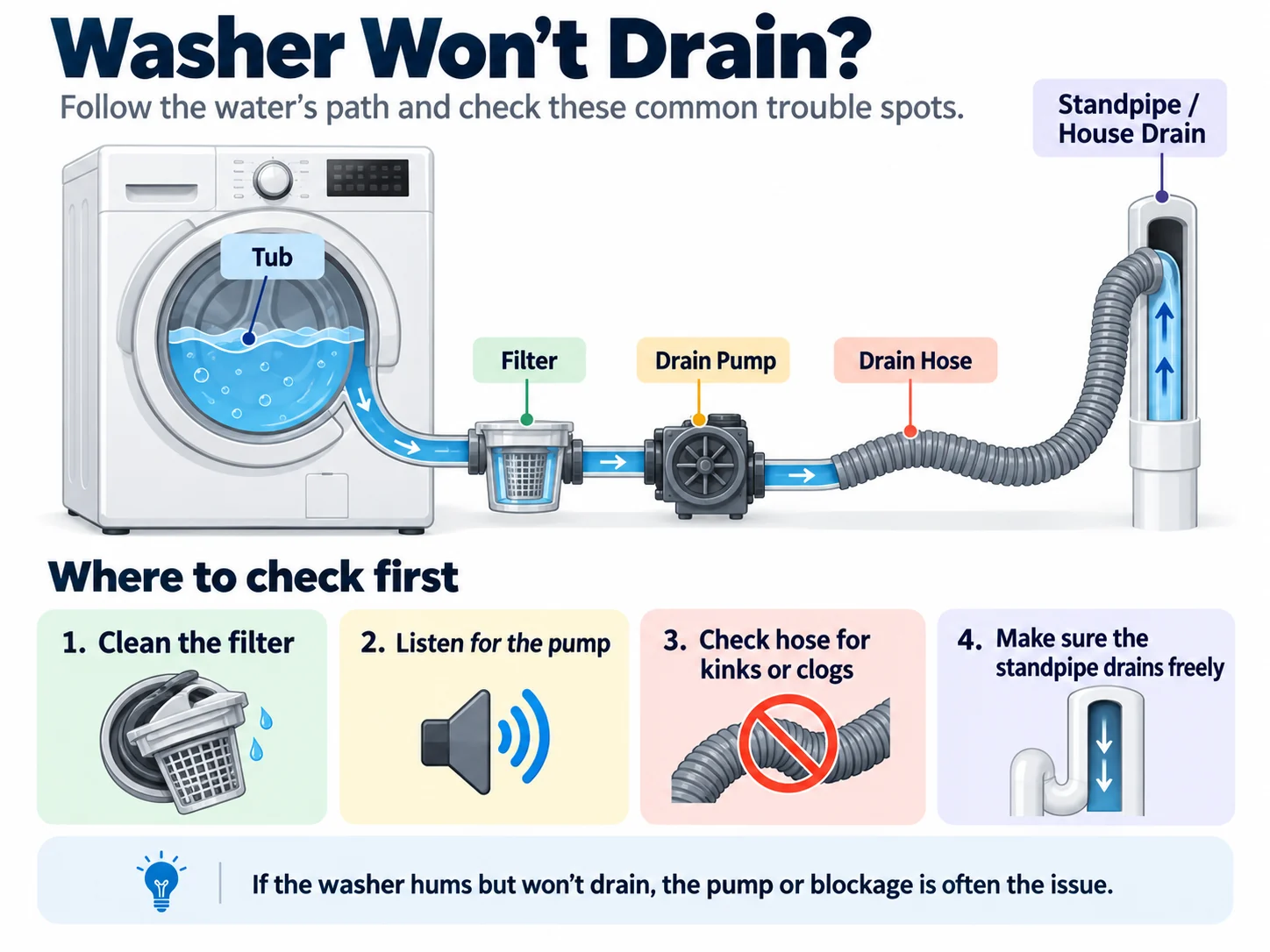
Most Likely Causes
| Cause | What You May Notice | Difficulty |
|---|---|---|
| Clogged drain pump filter | Gradual slowing, bad smell, debris when opened | Easy |
| Kinked or crushed drain hose | Started right after moving the machine | Easy |
| Object stuck in the pump | Rattling or grinding during drain, pump hums | Moderate |
| Drain hose inserted too far | Water siphons out mid-cycle, or drains very slowly | Easy |
| Blocked household standpipe | Water backs up around the hose, other drains slow too | Moderate |
| Failed drain pump | No sound at all during drain, no water movement | Technician recommended |
| Door lock fault stopping the cycle | Cycle stops early with water still in | Technician recommended |
1. The Drain Pump Filter
Most front-load washers have a filter ahead of the pump that catches anything the pump cannot handle. It is designed to be opened by the owner, and it is the first place to look.
How to check: find the small access panel at the bottom front of the machine. Have a shallow pan and towels ready, because a full tub holds more water than the pan will. Many machines have a short drain spout next to the filter for exactly this. Unscrew the filter slowly and let the water out in stages.
What you may find: coins, hair clips, buttons, screws, pet hair, and a compacted felt of lint. A filter that has not been opened in a year or two is often almost solid.
What it means: if the filter was blocked, that was almost certainly the whole problem. Clean it, rinse it, refit it firmly, and run a short cycle to confirm.
2. Drain Hose Problems
The drain hose is the most easily damaged part of the drain path, and it sits where you cannot see it.
What you may notice: the problem appearing immediately after the washer was moved, installed or pushed back against a wall.
How to check: pull the machine out and follow the hose from the back of the washer to the standpipe or sink connection. Look for kinks, tight bends and flattened sections. Then check the end: it should sit loosely in the standpipe, not be jammed in.
Why the insertion depth matters: if the hose seals against the pipe, the drain cannot vent, and the machine either drains slowly or siphons water out during the cycle. If the hose sits too low, water can drain out continuously and the machine will keep refilling.
3. Something Caught in the Pump
Small hard objects get past the filter or reach the pump from the tub side.
What you may notice: a rattling, grinding or clicking noise during the drain phase, or a pump that hums under load without moving water.
How to check: with the machine unplugged and the tub drained, a blockage in the pump impeller is sometimes visible and reachable through the filter opening. Turn the impeller by hand if you can reach it; it should move freely.
What to do next: if the obstruction is not reachable from the filter, getting to the pump means tilting or opening the machine. That is a reasonable stopping point.
4. Failed Drain Pump
If the drain path is clear and nothing happens at all during the drain phase, the pump itself may have failed.
What you may notice: complete silence during drain, where you would normally hear the pump. Compare against how the machine used to sound; that contrast is the most useful evidence you have.
What to do next: pumps do wear out and are a routine repair, but confirming a dead pump means testing it electrically. Have a technician confirm before buying parts.
5. The Household Drain
Sometimes the washer is fine and the plumbing is not.
How to check: run water into a nearby sink or tub. If those also drain slowly, or if water backs up around the washer hose at the standpipe, the blockage is in the house drain.
What to do next: this is a plumbing job, not an appliance repair.
What Your Symptoms Mean
- Water sits in the drum and the door stays locked.Normal safety behaviour with water present. Drain through the filter before trying to force anything.
- Drains very slowly but does eventually empty.Partial restriction: filter, hose kink or the standpipe.
- Pump runs loudly but water does not move.Blockage at the pump or the filter.
- Complete silence during the drain phase.Pump, its wiring, or the control.
- Water backs up out of the standpipe.House plumbing.
- Started right after the machine was moved.Hose kink, almost certainly.
- Clothes come out soaked and the machine did not spin.The washer will not spin with water in the tub. Fix the drain first, then see a washer that will not spin.
When to Call a Technician
Do yourself: the filter, the hose, the standpipe depth, and running a drain-only cycle.
Call a technician when the drain path is clear and the pump makes no sound, when the machine stops mid-cycle with an unrelated fault, or when you would have to tip the machine over to reach the pump. Call a plumber instead if other drains in the house are slow.