Oven Not Heating: Rule Out the Settings First
An oven that will not heat is one symptom covering two completely different machines, plus a handful of modes that stop heating on purpose. Sorting out which of the three you are looking at takes a couple of minutes and saves a lot of wasted effort.
Quick answer
Start with the settings that can genuinely prevent a cycle from starting: Control Lock, Delayed Start and Demo/Showroom mode on models that have them. A door that is not fully closed can also stop heating on some models. Sabbath mode is different: on many ranges it keeps Bake running while changing controls, tones and display behavior, so check the manual rather than treating Sabbath as a universal no-heat cause. After that, split electric from gas. Electric ovens point toward supply, bake/broil circuits, sensors or controls; gas ovens commonly point toward the igniter, gas supply or safety-valve circuit.
Narrow down the cause
Answer a few questions about what your oven is actually doing. It takes about a minute and nothing is saved.
What is your oven doing?
Loading the questions…
The questions could not be loaded. The written guide below covers the same ground.
Start With These Quick Checks
- Close the oven door fully. Some models suspend heating or fans when the door is open, and a rack or oversized pan can keep the door switch from registering correctly.
- Look for a lock symbol or the words Control Lock. On many models this is cleared by holding one specific button for about three seconds. The manual will name it, because it varies by brand.
- Cancel everything and start again. A delayed start that is still counting down looks exactly like an oven that refuses to heat. Press Cancel or Off, then set a plain Bake cycle at a normal temperature.
- If the display shows Sabbath/Sab, check the manual before changing anything. Sabbath mode changes keys, tones and display behavior; on many Whirlpool-family models it actually keeps Bake operating rather than disabling heat.
- Check for demo or showroom mode. Ranges sold from a display floor sometimes arrive with it enabled. The panel responds normally and nothing heats at all.
- Establish which type of oven you have. Gas burner under the oven floor, or electric elements you can see at the top and bottom? Dual-fuel ranges have a gas cooktop and an electric oven, which catches people out.
- Check whether the cooktop still heats normally. If surface elements and other 240-volt loads also fail or heat poorly while the clock works, check the supply. If the cooktop heats normally and only the oven is cold, an oven-specific fault becomes more likely.
If you smell gas at any point, stop. Do not operate switches, do not try to find the source, leave the building and call your gas utility or 911 from outside.
Electric or Gas: Which Path to Follow
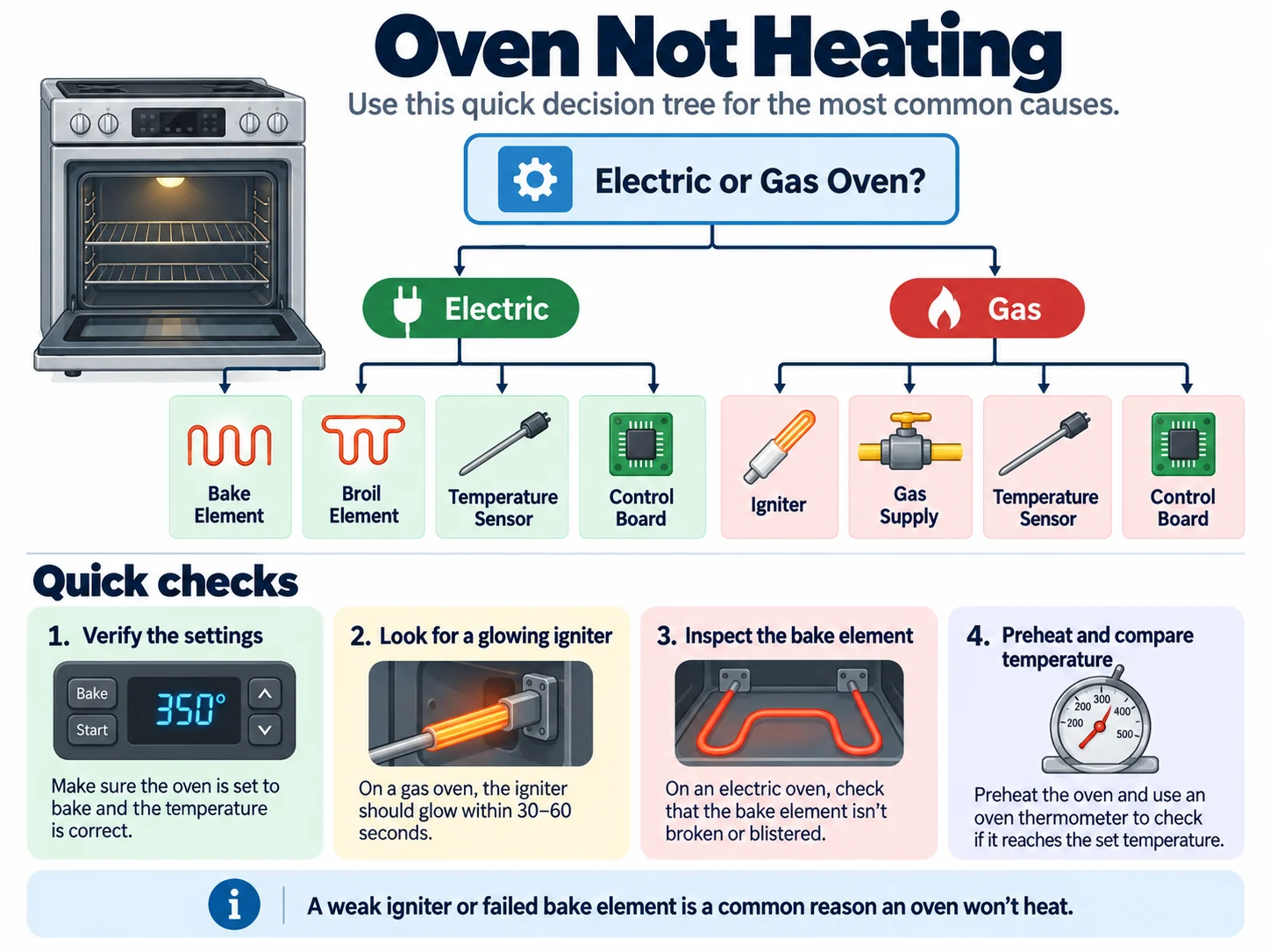
Most Likely Causes
| Cause | What You May Notice | Difficulty |
|---|---|---|
| Control lock, delayed start or demo mode | Panel alive but a normal Bake cycle will not start | Easy |
| Door not fully closed on models that inhibit heating with the door open | Intermittent, often after loading a large tray | Easy |
| Partial 240-volt supply or connection fault | Electric range: clock/display works while multiple heating loads fail or heat poorly | Easy first check; electrician if persistent |
| Bake element failed | Electric oven, broil may still work, sometimes a visible blister | Moderate |
| Igniter weak or failed | Gas oven, igniter glows but the burner never lights | Technician recommended |
| Temperature sensor fault | Oven heats briefly or reports an error code | Technician recommended |
| Control board or relay fault | Erratic behavior, elements that never energize on any mode | Technician recommended |
1. Modes That Stop an Oven Heating on Purpose
This is the first section rather than a footnote because it accounts for a meaningful share of these complaints, and every one of them is free to rule out.
Control lock can prevent the oven from accepting a start command. Delayed start intentionally leaves the oven idle until the programmed time. Demo or showroom mode can leave the display and menus active while heating is disabled.
Sabbath mode needs separate treatment. Its behavior is model-specific, and on many Whirlpool-family ranges it keeps a Bake cycle running while disabling tones and limiting control changes. Seeing “Sab” on the display therefore does not by itself explain a cold oven.
What you may notice: the control is alive but a plain Bake cycle does not start as expected, or the display shows a mode you do not normally use.
How to check: press Cancel/Off, select a simple Bake cycle, and consult the owner’s manual for any lock, delay, demo or Sabbath indicator. Do not guess from the icon alone.
What it means: settings are free to rule out before moving to power or component faults.
2. Half the Supply on an Electric Range
An electric range runs on a 240-volt circuit fed by a double breaker. The clock, lights and control electronics generally run on 120 volts, while the heating elements need the full 240.
What you may notice: the display and oven light work, but several 240-volt heating loads fail or heat weakly. GE notes that partial voltage can leave the clock working while burners do not heat properly. If the surface elements heat normally and only the oven is affected, a missing supply leg is less likely.
How to check: switch the range breaker firmly all the way off, then back on. On a newly installed range, manufacturer guidance also points to the power connection and terminal block. Do not open the terminal block yourself; persistent partial-power symptoms need an electrician or qualified technician.
What it means: this costs nothing to test. If the breaker trips again immediately, stop and call an electrician.
3. The Bake Element (Electric Ovens)
On ovens with an exposed bake element, it is the heating coil along the bottom of the cavity. Many newer ovens hide the bake element beneath the oven floor, so there may be nothing visible to inspect.
What you may notice: the oven stays cold on Bake. Often Broil still works, because that is a separate element at the top, and that split is a useful clue. A failed element sometimes shows a visible blister, break or burn mark, though not always.
How to check: if your model has an exposed element, inspect it only with the oven cold and power off at the breaker for blisters, breaks or burn marks. Do not remove the oven floor or expose live wiring for a visual test. Comparing Bake with Broil can be a useful symptom clue, but a hidden element needs model-specific diagnosis.
What it means: elements are among the more straightforward parts on a range, but replacing one means disconnecting mains wiring inside the cavity. If you are not confident the circuit is dead, this belongs to a technician.
4. The Igniter (Gas Ovens)
A gas oven does not simply open a valve. The igniter draws current, and the gas safety valve opens only once that current reaches the level the valve requires. An igniter that has weakened with age still glows brightly while failing to draw enough current to open the valve.
What you may notice: the igniter glows orange under the oven floor for a long time, and the burner never lights. A glowing igniter is not proof that it is healthy: on hot-surface ignition systems it can glow while drawing too little current to open the safety valve. That is a common possibility, but gas supply, valve and control faults can produce overlapping symptoms.
What to do next: do not test or adjust anything in the gas train. If the appliance gas shut-off is safely accessible without moving the range, confirm it has not been intentionally closed; otherwise leave the connection alone. Check whether other gas appliances work, then call a qualified technician and describe the glow-but-no-flame symptom.
5. The Temperature Sensor
Most modern ovens measure cavity temperature with a sensor probe rather than a mechanical thermostat. If the control reads an implausible value, it may refuse to heat at all rather than run blind.
What you may notice: an error code, or an oven that heats for a short time and then stops. If your oven heats but to the wrong temperature, that is a different problem — read our guide on an oven that will not reach temperature.
What it means: sensor replacement is a common repair, but diagnosing it properly means resistance measurements against the manufacturer’s table for your model.
What Your Symptoms Mean
- Panel alive but a normal Bake cycle will not start.Check Control Lock, Delayed Start and Demo/Showroom mode first; interpret Sabbath mode from the manual rather than assuming it disables heat.
- Cooktop heats normally but oven does not, electric range.A missing 240-volt leg is less likely; focus on oven settings and oven-specific components. If multiple heating loads are weak or dead while the clock works, check the supply.
- Bake cold but Broil works.Points at the bake element rather than the control.
- Igniter glows for a long time but no flame appears.A weak igniter is a common possibility on hot-surface ignition systems, but the gas supply/safety-valve circuit also needs professional diagnosis.
- No igniter glow and no flame on a gas oven.Think ignition power/control/igniter first; the gas supply alone does not explain an igniter that never energizes.
- Heats briefly then stops, or shows an error code.Temperature sensor or control.
- Heats, but food is wrong and the temperature seems off.Not this article. See the temperature guide.
- Nothing on the display at all.Not a heating problem. See our guide on a range with no power.
When to Call a Technician
Do yourself: clearing Control Lock or Delayed Start, disabling Demo mode per the manual, verifying any Sabbath indication per the manual, closing the door properly, resetting the breaker, checking whether the cooktop heats normally, and inspecting an exposed element for visible damage with the power off.
Call a qualified technician for anything involving the gas train on a gas oven, for element or sensor replacement, when a breaker trips repeatedly, or when the oven reports an error code you cannot clear.
Gas oven work in particular is not a place to experiment. On hot-surface ignition systems, the igniter and safety-valve circuit is designed so gas is released only when the ignition conditions are met; other gas-oven designs use different safeguards. Follow the service information for the specific model.
Sources