Dishwasher Not Drying: Rinse Aid, Cycle or Heat?
A wet load does not automatically mean a failed heater. The useful distinction is whether only certain materials stay wet or the entire load comes out cool and damp.
Quick answer
Start with the pattern. If plastics are wet while glass and ceramic are mostly dry, that is usually normal: plastics retain less heat and shed water less readily. If everything is wet, check the rinse-aid level, the selected cycle or dry option, loading that traps water, and whether the machine produced a hot final rinse. Condensation-drying models can also leave more visible moisture on plastics than heated-dry designs.
Narrow down the cause
Answer a few questions about what your dishwasher is actually doing. It takes about a minute and nothing is saved.
What is your dishwasher doing?
Loading the questions…
The questions could not be loaded. The written guide below covers the same ground.
Start With These Quick Checks
- Note which items are wet. Plastics only, or everything? That distinction sets the direction for the rest of the checks.
- Check the rinse aid dispenser. It is usually next to the detergent cup. Rinse aid is one of the first things manufacturers recommend checking because it helps water sheet off dishes instead of remaining as droplets.
- Check which cycle you used. Eco, Quick and Light cycles may reduce heat or drying time to save energy, depending on the model.
- Look for a drying option you may have turned off. Heated Dry, Extra Dry, Sanitize and similar options can improve drying on many models, but the exact behavior varies by dishwasher.
- Look at the bottoms of upturned cups and mug bases. Pooled water there is a loading issue, not a drying issue.
- After the cycle finishes and the steam has cleared, note whether the dishes and tub are still warm. A load that is consistently cool after a cycle that should include a hot final rinse is a useful clue, but it is not a substitute for model-specific diagnostics.
- Unload the bottom rack first. Water sitting in the upper rack drips onto dry dishes below while you are emptying it, which makes drying look worse than it was.
Do not reach into a dishwasher immediately after a Sanitize cycle. The interior and the dishes reach temperatures that will scald.
What Drying Actually Depends On
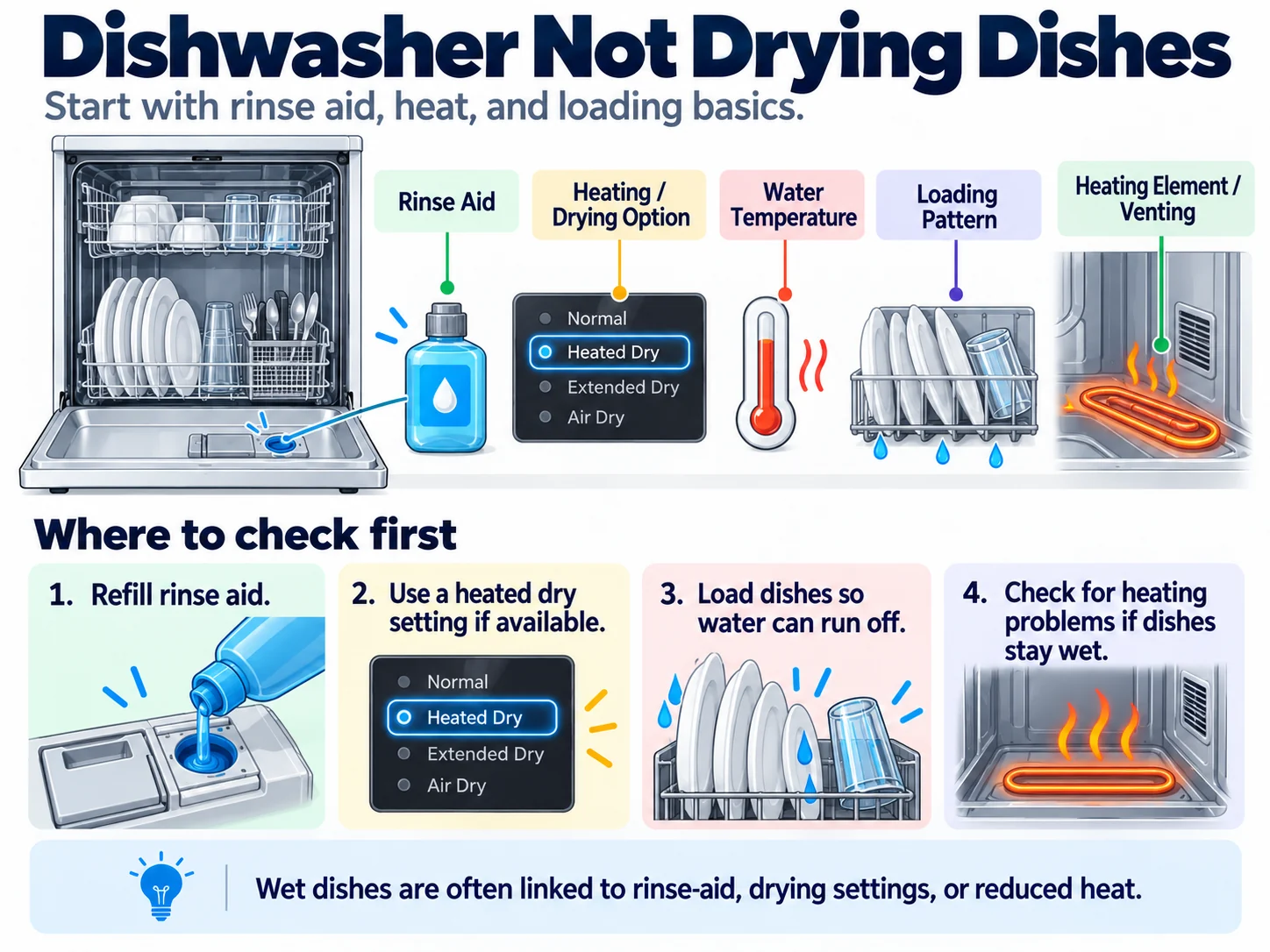
Most Likely Causes
| Cause | What You May Notice | Difficulty |
|---|---|---|
| Rinse aid empty | Water sits in beads and droplets rather than sheeting off; spotting too | Easy |
| Cycle or option uses reduced drying | Everything damp but clean; happens mainly on short or energy-saving cycles | Easy |
| Plastic items only | China and glass are dry, containers are soaked | Easy — not a fault |
| Loading traps water | Puddles on upturned cup bases and mug bottoms | Easy |
| Condensation-drying design | Plastics stay wetter; machine may rely on a hot final rinse and stainless-steel tub rather than an exposed heater | Easy — often normal |
| Final rinse not hot enough | Nothing is warm at the end, even on a heated cycle | Moderate |
| Heating element or vent fault | Heated cycles leave everything cold and wet, including china | Technician recommended |
1. Rinse Aid, and Why It Matters More Than People Expect
Rinse aid lowers the surface tension of water, helping the final rinse sheet off dishes instead of remaining as droplets. That leaves less water behind to evaporate and also reduces spotting.
What you may notice: droplets standing on glasses and plates, spotting after drying, and a general sense that the machine got worse over a few weeks rather than suddenly. Many all-in-one detergent tablets include a rinse agent, but in hard-water areas it is often not enough on its own.
How to check: open the rinse aid cap and look. Most machines have a small window or indicator showing the level. Fill it, run a normal load, and compare.
What it means: if drying improves after a refill, rinse aid was part of the problem. Refill when the dispenser indicator says it is low; the interval varies with the machine’s dose setting and how often you run it.
2. The Cycle You Chose
What you may notice: dishes come out clean but damp only on certain cycles. Short and energy-saving cycles often trade some drying performance for lower time or energy use.
How to check: run the same load on a Normal or Heavy cycle with Heated Dry or Extra Dry enabled, and compare. Also check whether an energy-saving mode is on, which on some machines silently disables the drying heat.
What it means: if a longer cycle or enhanced-dry option fixes the complaint, the dishwasher may be operating normally. Energy-saving cycles can trade some drying performance for lower energy use.
3. Plastic Containers
Plastic behaves differently from glass and ceramic during drying because it stores much less heat.
A hot final rinse leaves glass and ceramic with enough stored heat to help remaining water evaporate. Plastic retains much less heat and often has shapes or surface features that hold droplets, so it tends to stay wetter.
What you may notice: a load where the plates, bowls and glasses are perfectly dry and every plastic container is covered in droplets.
What it means: this pattern is usually normal. Put plastics where your manual recommends, angle them so water can drain, use rinse aid, and try the model’s enhanced-dry option if available. Some dishwashers dry plastics better than others.
4. Loading That Holds Water
What you may notice: a tablespoon of water sitting in the recessed base of every upturned mug, or in the foot ring of bowls.
How to check: look at how those items sit. Anything with a flat or recessed bottom facing up becomes a cup. Angle them, or use the rack tines that are shaped to tilt them.
What it means: pooled water in a recessed base is mainly a loading and geometry issue. Angle the item so it can drain, and unload the bottom rack first so water from the upper rack does not spill onto dishes below.
5. Condensation Drying
Some modern dishwashers use condensation drying instead of an exposed heating element. The hot final rinse heats the dishes; moisture then condenses on the cooler stainless-steel tub and runs down toward the drain. Other designs use hidden heaters, fans, automatic door opening or other drying systems.
What you may notice: the machine has behaved this way since new, plastics are wetter than glass or ceramic, and the manual describes condensation, fan-assisted or auto-open drying.
What it means: compare the result with the owner’s manual before assuming a failure. Rinse aid is especially important on many condensation-drying designs. If the manufacturer recommends opening the door after the cycle, follow that guidance; some models do it automatically.
6. No Heat at All
What you may notice: on a cycle that the manual says should provide a hot final rinse or active drying, the load stays cool and wet. Unlike the plastic-only pattern above, china and glass are affected too.
How to check: after a cycle that should use a hot final rinse or heated-dry option, wait for steam to clear and note whether the load is warm. Do not touch an exposed heating element. If the machine also cleans poorly, low water temperature or a heating-system fault can affect both symptoms.
What to do next: the drying system may involve an exposed or hidden heater, a fan, a vent, sensors or control components depending on the model. Diagnosis beyond the checks above means working around line-voltage parts in a wet appliance, so this is a reasonable point to call a technician. If washing performance also changed, mention that because a water-temperature problem can affect both washing and drying.
What Your Symptoms Mean
- Plastics wet, everything else mostly dry.Usually normal. Rinse aid, loading and enhanced-dry options may improve it.
- Everything damp, with water beading on glass.Check the rinse-aid level and loading first, then compare the cycle’s drying options.
- Everything damp, mainly on the quick or eco cycle.That cycle may use less heat, less drying time, or a different drying strategy. Compare with the manual or a normal cycle.
- Puddles only in upturned cup bases.Loading. Angle those items.
- Has been damper since new and the manual describes condensation or auto-open drying.Likely normal for the design; use the model-specific drying recommendations.
- Load stays cool and wet on a cycle that should provide a hot final rinse or active drying.A heating, venting or drying-system fault is possible; this is a reasonable point for service.
- Dishes dry but spotted or filmy.That is a water-quality question rather than a drying one.
- Dishes wet and still dirty.Treat it as a cleaning problem first; drying is downstream of it.
When to Call a Technician
Do yourself: fill rinse aid, compare cycle and drying options, reload plastics and upturned items, follow the manual’s end-of-cycle guidance, and unload the bottom rack first.
Call a qualified technician when the tub is cold at the end of a cycle that should apply heat, when china and glass come out as wet as plastic every time, or when drying stopped abruptly at the same time as a change in washing performance.
If rinse aid, loading and cycle selection do not change the result, use the model’s manual to identify its drying system before assuming a failed heater.
Sources