Dishwasher Pod Not Dissolving: What to Check First
The condition of the dispenser at the end of the cycle is a useful clue, but it is not a diagnosis by itself. Start there, then use the spray pattern, water temperature and cycle behavior to narrow the cause.
Quick answer
Open the door at the end and check the dispenser before changing anything. A closed cup with the pod still inside means the dispenser did not open fully — often because loading blocked the door, but a sticking latch is also possible. An open cup with a wet or partly dissolved pod points more toward weak spray, low water temperature, an interrupted or short cycle, or a damp pod. Follow the detergent package and your dishwasher manual for placement; on many U.S. built-in models, detergent packs belong in the main dispenser.
Start With These Quick Checks
- Open the door at the end of the cycle and look at the dispenser before touching anything. Closed with a pod inside, open with a pod inside, partly dissolved, or empty — each means something different.
- Check the detergent instructions and your dishwasher manual. On many U.S. built-in dishwashers, pre-measured packs go in the main detergent compartment with the lid closed. Putting a pack loose in the tub can release detergent too early on cycles that include an initial drain or pre-wash. If your product or appliance specifically instructs a different placement, follow that instruction.
- Look at what stands in the front row of the lower rack. The dispenser door swings outward and downward. A large plate, a cutting board or a baking tray in front of it will hold it shut.
- Run the hot faucet at the nearest sink until it is hot, then start the cycle. Several manufacturers recommend about 120°F (49°C) incoming water for good wash performance. Purging the cold water from the line gives the dishwasher a warmer first fill.
- Check the dispenser cup for old residue. Caked detergent from previous cycles can stop the flap latching or opening cleanly.
- Feel a pod from the box. Soft, tacky or stuck to its neighbors suggests the packs have picked up moisture, which can make the film stick to the dispenser.
- Make sure nothing is leaning against the inside of the door. Items in the upper rack can hang down over the dispenser once the door is closed.
Keep pods out of reach of children. They are brightly colored, concentrated, and a recognized poisoning hazard.
What Keeps a Pod From Dissolving
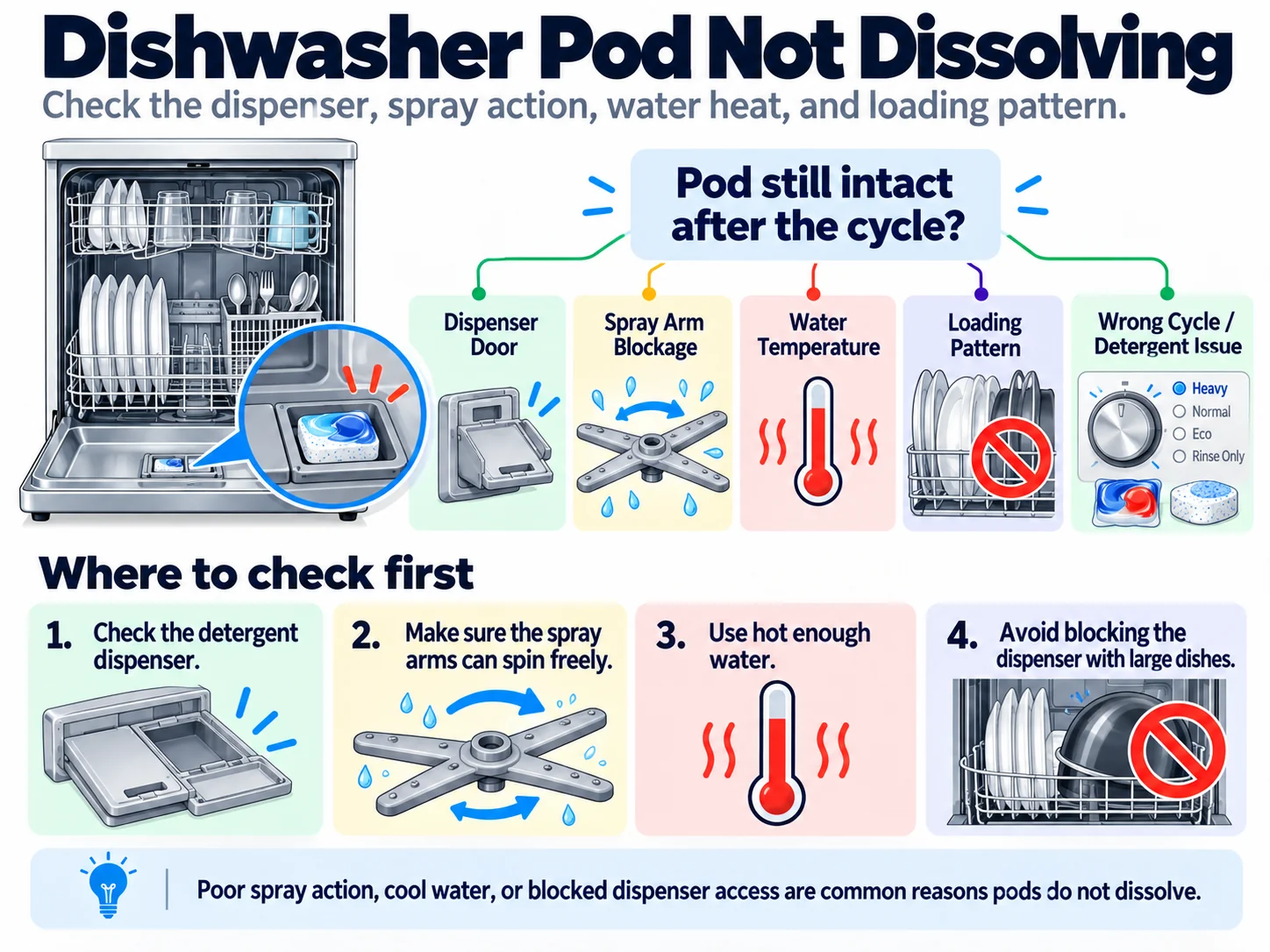
Most Likely Causes
| Cause | What You May Notice | Difficulty |
|---|---|---|
| Dispenser door blocked by loading | Cup still closed at the end, pod intact inside | Easy |
| Water too cold | Pod partly dissolved, sticky gel in the cup, film left behind | Easy |
| Damp or clumped pods | Pod stuck to the cup, sometimes torn | Easy |
| Dispenser residue or sticking flap | Cup closed, visible caked detergent around the hinge | Easy |
| Weak spray reaching the cup | Cup open, pod intact and dry-looking | Moderate |
| Dispenser latch or solenoid fault | Cup never opens on any cycle, nothing blocking it | Technician recommended |
1. Something Blocked the Dispenser Door
A blocked dispenser door is common and easy to rule out. A cup that is still shut at the end of the cycle with the pod inside is strong evidence that the door did not open fully.
The detergent cup has a spring-loaded or sliding door that is released during the wash. If cookware or a rack position blocks that door, it may not open far enough for detergent to wash out. The exact dispenser design varies by model.
What you may notice: a closed cup with a dry, intact pod. The dishes are washed in water with no detergent in it, so they come out rinsed rather than cleaned.
How to check: load as usual, then crouch down and look straight at the dispenser with the racks in place. Nothing should be within a few inches of it. Large plates and chopping boards belong along the sides of the lower rack, not across the front.
What it means: if changing the load lets the dispenser open normally on the next cycle, the appliance itself probably does not need repair.
2. The Pod Was Loose in the Tub
Loose-in-tub placement is not universally correct or incorrect — it depends on the detergent and the dishwasher. Many U.S. built-in dishwasher manuals specify the main detergent compartment because the machine releases detergent at the intended point in the cycle.
If a pack is placed loose in the tub on a cycle that includes an initial drain or pre-wash, some detergent can be released earlier than intended. That can leave too little detergent available for the main wash. Follow the package directions and the appliance manual rather than a generic rule.
What you may notice: the dispenser is empty because no pack was placed there, the dishes are poorly cleaned, and the cycle used an initial drain or pre-wash.
What it means: use the detergent location specified by your dishwasher and detergent manufacturer. If the machine calls for the main dispenser, putting the pack there also makes troubleshooting much easier.
3. Water That Was Too Cold
The water-soluble film on a detergent pack dissolves more reliably when the dishwasher receives water within the temperature range recommended by the manufacturer. Water that is too cool can contribute to residue, especially on short cycles, but it is not the only cause.
What you may notice: the cup is open, but there is sticky residue in it or a piece of film remains on the side.
How to check: run the hot faucet at the nearest sink until it is hot, then start a normal cycle. If your manual specifies an incoming-water target, check that temperature at the faucet. Also make sure the cycle completed normally.
What it means: if the residue disappears on the next load, low inlet temperature or the shorter cycle was likely part of the problem. If it does not, look next at spray action and the dispenser.
4. Damp or Clumped Pods
The water-soluble film is moisture-sensitive. If packs are stored in a humid place or handled with wet hands, the film can soften and stick to the container or dispenser before the cycle starts.
What you may notice: pods that feel tacky, that cling to each other in the container, or that bond to the inside of the dispenser cup and tear when the flap opens.
What it means: store them sealed, dry and away from the sink. Handle them with dry hands — damp fingers start the film dissolving before the pod is even in the machine.
5. Residue Around the Dispenser
What you may notice: a crust of old detergent around the hinge or the rim of the cup, and a flap that does not snap shut crisply or does not swing fully open.
How to check: with the machine off, wipe the cup and the hinge area with a damp cloth and an old toothbrush. Work the flap by hand a few times to confirm it moves freely.
What it means: a sticking flap that opens late dumps detergent into the wrong phase of the cycle, which looks like a dissolving problem but is really a timing problem.
6. The Spray Never Reached the Cup
What you may notice: the cup is open, the pod is intact and still looks dry. The flap did its job; the water did not arrive.
How to check: this points away from the dispenser and toward circulation. Check the spray arms turn freely, that their holes are clear, and that the machine is filling properly. Both poor cleaning and a fill problem produce this result.
What it means: fixing the dispenser will not help. The fault is upstream of it.
7. Do Not Confuse Mineral Film With Pod Residue
In hard-water areas, dissolved calcium and magnesium can contribute to mineral film and reduce wash performance. That can make a detergent-residue complaint look worse even when the pack itself dissolved normally. Water hardness is a property of the supply, not the dishwasher.
What you may notice: a chalky film on glasses alongside the residue, and the sense that more detergent never quite fixes it.
What it means: hard water does not by itself explain an intact pod. If the pack is gone but a chalky haze remains, treat that as a separate water-quality issue. Rinse aid can help with spotting, and some dishwashers have a built-in water-softening system that should be set according to the manual.
What Your Symptoms Mean
- Cup closed, pod whole and dry inside.The dispenser did not open. Check loading or anything obstructing the flap first; if nothing blocks it, the dispenser mechanism may need service.
- Cup open, pod mostly whole or dry-looking.Check spray action, fill and whether the cycle completed.
- Cup open, sticky gel or film residue.Low water temperature, a short or interrupted cycle, damp detergent or weak spray are all plausible.
- No pack was placed in the dispenser and dishes are dirty.Check the package/manual placement instructions; detergent may have been released too early for that cycle.
- Pod torn or stuck to the cup.Damp pods. Check how they are stored.
- Caked detergent around the hinge.Residue can make the flap stick. Clean it and confirm it moves freely with the machine off.
- Cup never opens on any cycle, with nothing in the way.A dispenser actuator, latch, wiring or control fault is possible. That is a service call.
- Pod dissolves fine but dishes are still dirty.The detergent is not the problem. Start with the cleaning guide instead.
When to Call a Technician
Do yourself: keep the dispenser door clear, follow the detergent and dishwasher instructions for pack placement, purge cold water from the hot-water line when the manufacturer recommends it, clean residue from the dispenser, and store packs dry.
Call a qualified technician when the dispenser never opens on any cycle with nothing obstructing it, when the flap is physically broken or will not latch, or when the pod stays dry in an open cup after the spray arms and the fill have both been checked.
Start with placement, loading, temperature and spray action before replacing the dispenser. Those checks are inexpensive and cover the common non-part failures.
Sources