Dishwasher Won't Drain: Filter, Hose and Disposal
Before troubleshooting, note that a shallow pool of clean water around the filter is by design on many dishwashers. A tub with several inches of dirty water is a different matter.
Quick answer
Water left in the bottom of a dishwasher usually means the filter is clogged, the drain hose is kinked or blocked, or the air gap is full of debris. If the dishwasher was recently installed and has never drained, the most likely cause is the knockout plug inside the garbage disposal inlet, which has to be removed during installation. A small amount of clean water in the sump is normal and is not a fault.
Narrow down the cause
Answer a few questions about what your dishwasher is actually doing. It takes about a minute and nothing is saved.
What is your dishwasher doing?
Loading the questions…
The questions could not be loaded. The written guide below covers the same ground.
Start With These Quick Checks
- Confirm it is actually a fault. A small amount of water in the sump area keeps seals from drying out on many models. Several inches of standing dirty water is a real problem.
- Pull out the bottom rack and remove the filter. On most modern dishwashers this twists out by hand. Food debris, glass chips and labels from jars collect here.
- Check the drain hose under the sink. Look for kinks and crushed sections, especially where it passes through the cabinet.
- Check the air gap if there is one on the countertop. Pop the cover and clear any debris inside. It is a small cylinder next to the faucet.
- Run the garbage disposal for a few seconds. If the disposal is blocked, the dishwasher cannot drain through it.
- If the dishwasher is newly installed, check the disposal knockout plug. New disposals ship with the dishwasher inlet sealed. If nobody knocked it out, the dishwasher will never drain.
- Run a rinse cycle and listen. A pump you can hear working is a different problem from silence.
How the Dishwasher Drain Path Works
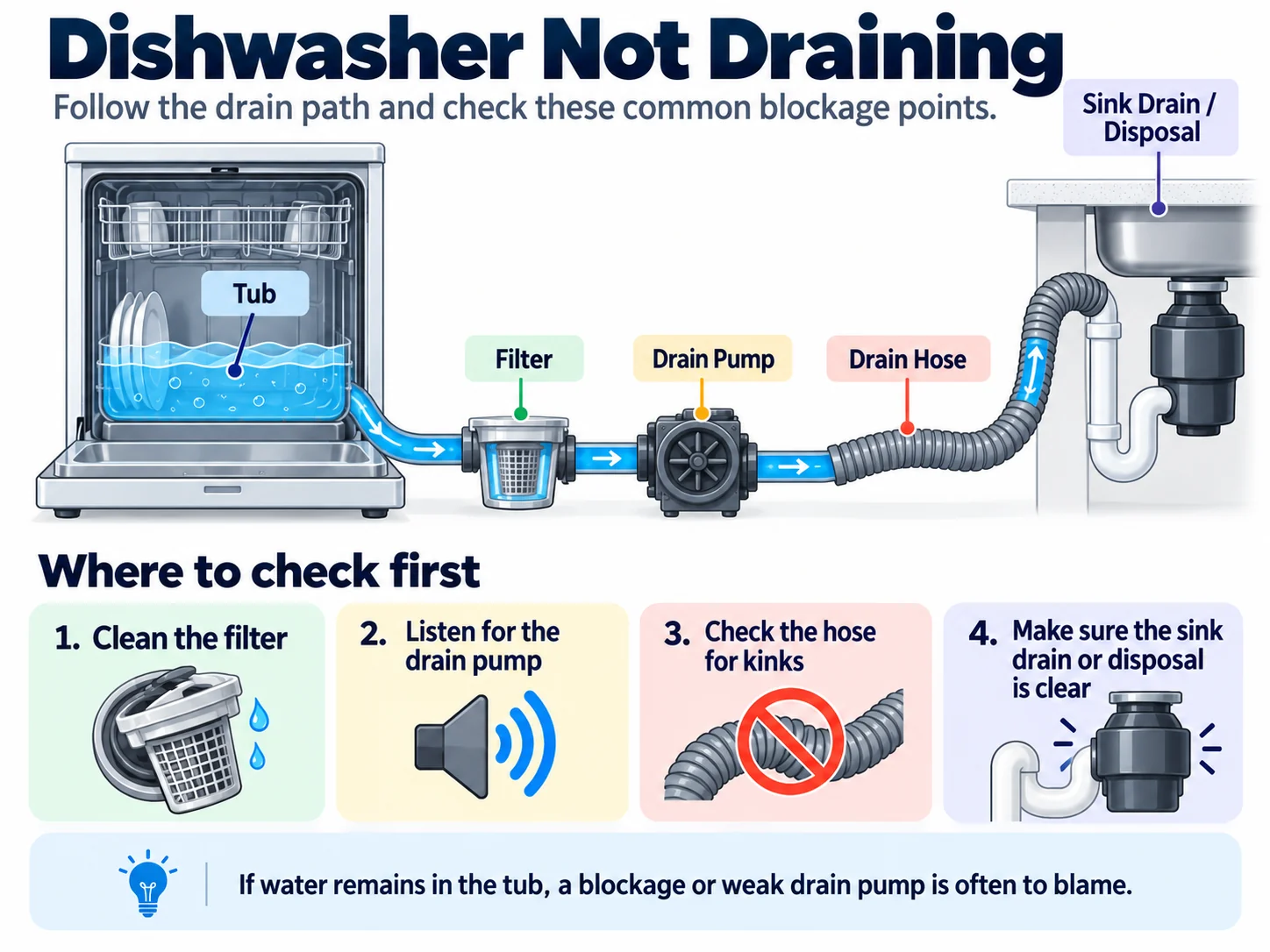
Most Likely Causes
| Cause | What You May Notice | Difficulty |
|---|---|---|
| Clogged filter | Gradual decline, food debris visible, poor cleaning too | Easy |
| Kinked drain hose | Started after work under the sink | Easy |
| Blocked air gap | Water backing up onto the countertop or into the sink | Easy |
| Disposal knockout plug in place | New installation that has never drained properly | Easy |
| Blocked garbage disposal | Sink drains slowly as well | Easy |
| Debris in the drain pump | Rattling during drain, pump audible but no water movement | Moderate |
| Failed drain pump | Silence during the drain phase | Technician recommended |
1. The Filter
Nearly every dishwasher made in the last decade has a removable filter in the base. It catches food particles, and it needs cleaning periodically. Many owners have never been told it exists.
How to check: remove the lower rack. The filter is usually a cylinder you twist counter-clockwise and lift out, often with a flat mesh screen underneath.
What you may find: softened food, seeds, bits of label, and sometimes glass or bone fragments.
What to do next: rinse it under a tap, use a soft brush for the mesh, and refit it properly. It must lock back in place, because running the machine without the filter seated lets debris reach the pump.
What it means: if poor cleaning performance came along with the drainage problem, a clogged filter explains both.
2. The Drain Hose
The hose runs from the dishwasher to either a garbage disposal inlet, a dedicated drain tailpiece, or an air gap.
What you may notice: the problem starting right after someone worked under the sink or stored something bulky in that cabinet.
How to check: open the cabinet and follow the hose. Look for kinks, crushing, and sharp bends. Check that it is routed with a high loop or through an air gap, which is what stops sink water siphoning back into the dishwasher.
3. The Air Gap
If there is a small chrome cylinder on the countertop next to the faucet, that is an air gap, and it can clog.
What you may notice: water bubbling up out of the air gap during the drain phase, or spilling into the sink.
How to check: lift off the chrome cover and unscrew the plastic cap underneath. Clear out any debris inside.
4. The Garbage Disposal Knockout Plug
This one catches a lot of people, and it only applies to a newly installed dishwasher or a newly installed disposal.
Garbage disposals ship with the dishwasher inlet sealed by a moulded plug. Whoever installs the dishwasher is supposed to knock that plug out. If they did not, the drain hose connects to a sealed port and the dishwasher can never drain.
What you may notice: a dishwasher that has never drained properly since the day it was installed.
What to do next: with the disposal unplugged or its breaker off, the plug is knocked out through the dishwasher inlet from inside the disposal. Make sure to retrieve the plug afterwards so it does not end up in the disposal.
5. Blocked Disposal or Sink Drain
If the dishwasher drains into the disposal, anything blocking the disposal blocks the dishwasher.
How to check: run the disposal, then fill and drain the sink. Slow sink drainage points at plumbing rather than the dishwasher.
6. Debris or Failure in the Drain Pump
If everything upstream is clear, the pump is next.
What you may notice: a rattle or grinding during the drain phase suggests something caught in the impeller. Complete silence where you would normally hear the pump suggests it is not running at all.
What to do next: reaching the pump usually means removing the lower spray arm and the sump cover, and on many models pulling the machine out. If you are comfortable and the power is off at the breaker, clearing visible debris is sometimes straightforward. Testing or replacing a pump is a technician’s job.
What Your Symptoms Mean
- A small amount of clean water around the filter.Normal on many models.
- Several inches of dirty water after every cycle.Filter, hose or disposal.
- Water backs up into the sink or out of the air gap.Air gap or disposal blockage.
- Never drained since installation.Knockout plug, almost certainly.
- Drains slowly but does empty.Partial restriction, usually the filter.
- Rattling during drain.Debris in the pump.
- Silence during drain.Pump or control.
- Dishes are also coming out dirty.Clogged filter explains both at once.
When to Call a Technician
Do yourself: the filter, the drain hose, the air gap, the disposal and its knockout plug.
Call a technician when the drain path is confirmed clear and the pump is silent, when you would need to pull the machine out from under the counter, or when the dishwasher trips a breaker. Turn the power off at the breaker before reaching into the sump, and be careful of glass fragments.