Washer Won't Spin: Load Balance, Draining and Lids
Wet, heavy clothes at the end of a cycle mean the final spin did not run, or ran and gave up. The order you check things in matters here, because one cause hides the others.
Quick answer
A washer will not spin if it cannot drain first, so check for standing water before anything else. After that, the most common causes are an unbalanced load that the machine refuses to accelerate, a lid switch or door lock that is not confirming closed, and on older belt-driven machines a worn or broken drive belt. Redistributing the load by hand and running a spin-only cycle resolves a surprising share of cases.
Narrow down the cause
Answer a few questions about what your washer is actually doing. It takes about a minute and nothing is saved.
What is your washer doing?
Loading the questions…
The questions could not be loaded. The written guide below covers the same ground.
Start With These Quick Checks
- Look for standing water. A washer will not spin while there is water in the tub. If there is, that is the actual problem: see a washer that will not drain.
- Open the door and redistribute the load by hand. One towel or a pair of jeans bunched on one side is enough to stop a spin. Spread everything evenly around the drum.
- Run a spin-only or drain-and-spin cycle. This tests the spin directly instead of waiting through a whole wash.
- Try a smaller load. Very large or very small loads both cause balance problems. A single heavy item is one of the worst cases.
- Check the machine is level. Rock it corner to corner. A washer that moves during spin will slow itself down or stop.
- On a top-loader, check the lid closes fully. These machines use a lid switch and will not spin without it.
- Check the cycle you selected. Delicate, hand-wash and some wool cycles use a much lower spin speed by design, and some use almost none.
What Stops a Washer From Spinning
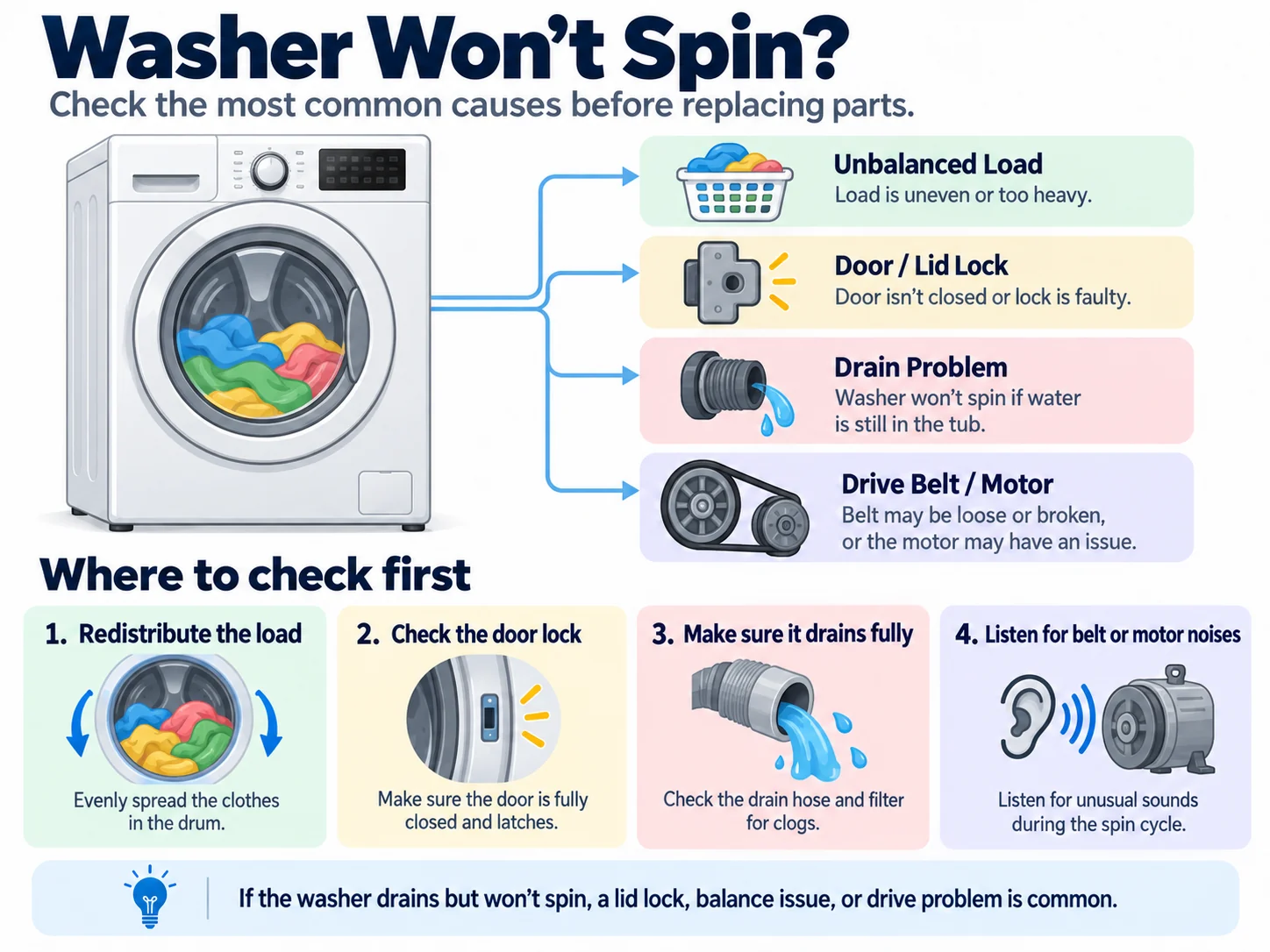
Most Likely Causes
| Cause | What You May Notice | Difficulty |
|---|---|---|
| Water not draining | Standing water in the tub at the end of the cycle | Easy |
| Unbalanced load | Machine tries, slows down, tries again, gives up | Easy |
| Low-spin cycle selected | Only happens on certain cycles, clothes wetter than usual | Easy |
| Machine not level | Banging or walking during spin, then an early stop | Easy |
| Lid switch or door lock fault | Machine fills and washes but never spins, no error obvious | Moderate |
| Worn or broken drive belt | Motor runs, drum does not turn, possibly a burning rubber smell | Technician recommended |
| Motor, coupler or control fault | No attempt to spin at all, or a hum with no movement | Technician recommended |
1. The Machine Cannot Drain
This is first for a reason. Spinning a tub full of water would throw the machine across the room, so every washer checks that the water is gone before it accelerates.
What you may notice: water visible in the drum, clothes dripping rather than damp, and a cycle that appeared to complete normally.
What to do next: solve the drain problem and the spin problem usually disappears with it. Start at the drain pump filter.
2. Unbalanced Load
Modern washers detect imbalance and refuse to speed up when they find it. What you see is a machine that starts to spin, slows down, redistributes, tries again, and eventually finishes the cycle without ever spinning properly.
Why it happens: a load spins at high speed. Anything off-centre creates a large force at those speeds. Bulky single items are the classic case: one bath mat, one comforter, one pair of heavy jeans.
How to check: open the door and look. If everything has migrated to one side, or wrapped itself into a rope, that is your answer.
What to do next: separate items by hand, spread them around the drum, and run a spin-only cycle. Add a couple of towels to a single heavy item so it has something to balance against.
3. Levelling and Movement
A washer that is not sitting evenly on all four feet will rock during spin. Machines respond to that by slowing down, and often by stopping.
How to check: push down on each corner in turn. If the machine rocks, adjust the feet until it sits solidly. Check the floor too: a washer on a springy wooden floor is much more sensitive to balance than one on concrete.
4. Lid Switch and Door Lock
A top-loader will not spin with the lid open, and a front-loader will not run at all without the door locked. Both use a switch to confirm it.
What you may notice: the machine washes normally but never spins, and there is no obvious error. On a top-loader you may hear a faint click when the lid closes; compare against how it used to sound.
Important: do not defeat the lid switch or hold the door lock closed with tape. It stops the drum spinning at high speed while it is open.
What to do next: switches and door locks are wear items and a common repair, but replacing one means opening the cabinet with the machine unplugged.
5. Drive Belt, Coupler or Motor
On machines that use a belt or a direct-drive coupler, the mechanical link between the motor and the drum can fail.
What you may notice: the motor clearly runs but the drum does not turn, sometimes with a smell of hot rubber. On a direct-drive top-loader, a failed coupler often produces a similar result: sound from the motor, nothing from the tub.
How to check: with the machine unplugged, the drum should turn freely by hand. A drum that spins with no resistance at all on a belt-driven machine points at a broken belt.
What to do next: this is a technician’s job on most machines.
What Your Symptoms Mean
- Standing water in the tub.Drain problem, not a spin problem.
- Tries to spin, slows, tries again, gives up.Unbalanced load, almost always.
- Clothes are damp but wetter than they used to be.Reduced spin speed. Check the cycle selected first.
- Washes normally, never attempts to spin.Lid switch, door lock, or control.
- Motor runs, drum does not turn.Belt, coupler or transmission.
- Bangs and walks across the floor.Levelling or load balance, and worth fixing before something else breaks.
- Only one cycle is affected.Probably the cycle’s designed spin speed, not a fault.
When to Call a Technician
Do yourself: redistributing the load, running a spin-only cycle, levelling the machine, checking the lid closes, and clearing the drain.
Call a technician when the motor runs but the drum does not turn, when there is a burning smell, when the machine has never spun since a specific event like a move, or when the drain is clear and balance is fine and it still refuses. Never bypass a lid switch or door lock to get a load finished.