Dryer Takes Too Long to Dry: Why Cycles Keep Running Long
The dryer gets hot, the cycle finishes, and the clothes are still damp. Running it again works, eventually. That pattern points somewhere very specific.
Quick answer
A dryer that heats but needs two or three cycles almost always has an airflow problem: a clogged lint filter, a crushed or lint-filled vent duct, or a blocked outside vent hood. Moist air has to leave the drum for clothes to dry, and when it cannot, the load simply reheats the same wet air. Overloading and a wet-heavy load from a washer that did not spin properly cause the same symptom.
Narrow down the cause
Answer a few questions about what your dryer is actually doing. It takes about a minute and nothing is saved.
What is your dryer doing?
Loading the questions…
The questions could not be loaded. The written guide below covers the same ground.
Start With These Quick Checks
- Clean the lint filter and test it with water. Fabric softener leaves an invisible film. If water sits on the screen rather than running through, wash it with warm soapy water and a soft brush.
- Feel the outside vent hood while the dryer runs. You want strong, warm airflow and a flap that stays pushed open. Weak flow is the whole answer in a lot of cases.
- Pull the dryer out and look at the duct. Flexible foil or plastic hose crushed behind the dryer is one of the most common causes, and one of the easiest to fix.
- Run one small load. If a half load dries in a normal cycle but a full load does not, the dryer is fine and the loads are too big.
- Check the laundry coming out of the washer. If it arrives heavier and wetter than it used to, the washer is not spinning properly and the dryer is being asked to do the washer’s job.
- Check the lint trap housing itself. Lint builds up in the slot below the filter. A vacuum crevice tool clears it.
Follow the Airflow Path
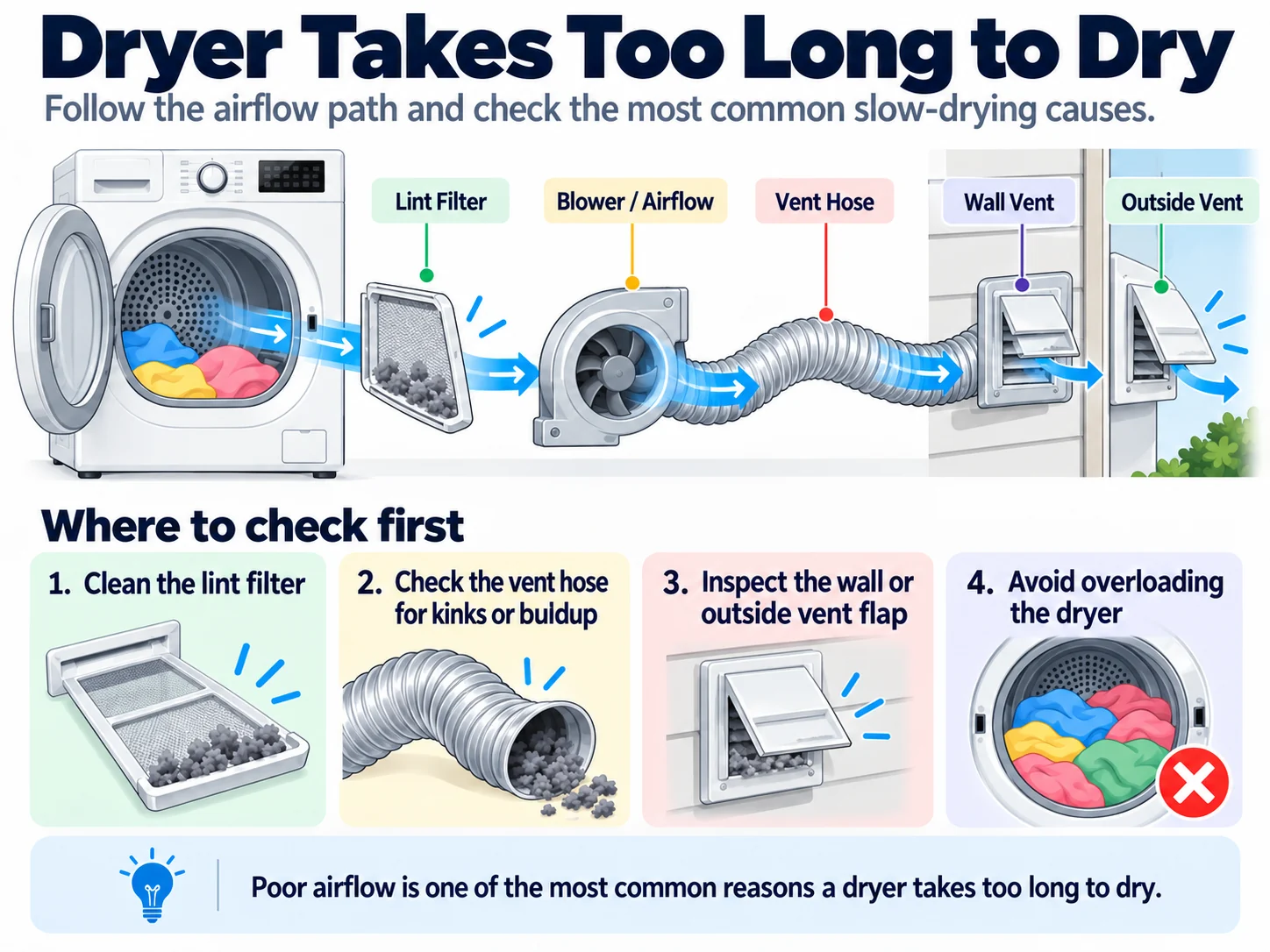
Most Likely Causes
| Cause | What You May Notice | Difficulty |
|---|---|---|
| Clogged lint filter or filter housing | Gradual decline over months, lint visible around the filter slot | Easy |
| Crushed or kinked vent duct | Dryer pushed tight against the wall, foil hose squashed behind it | Easy |
| Lint buildup inside the duct run | Long ducts, several bends, no cleaning in years | Moderate |
| Blocked outside vent hood | Weak flow outside, flap stuck shut, nesting material visible | Easy |
| Overloading | Only large loads are affected, small loads are fine | Easy |
| Washer not spinning fully | Clothes arrive at the dryer dripping or unusually heavy | Moderate |
| Weak heat from a partial fault | Drum warm rather than hot, all load sizes affected | Technician recommended |
1. Restricted Airflow Through the Vent
A dryer dries by moving air. Room air is pulled in, heated, passed through the tumbling clothes where it picks up moisture, and pushed out of the house through the duct. If that airflow drops, the moisture has nowhere to go, so the dryer keeps heating air that is already saturated.
This is why a long-cycle problem is usually not a heating problem. The heater is working. The air is not leaving.
How to check: run the dryer on a heated cycle and go outside to the vent hood. Strong, warm, steady airflow means the path is clear. Weak flow, or a flap that barely moves, means a restriction somewhere between the drum and the hood.
What it means: restriction is progressive. It builds over months, which is why people describe the dryer as “getting slower” rather than breaking. It is also worth fixing promptly, because a dryer that cannot exhaust runs hotter internally, and lint is flammable.
Rigid or semi-rigid metal duct performs far better than flexible foil or plastic hose, and it is much harder to crush. If you are replacing duct anyway, this is an easy upgrade.
2. Lint Filter and Filter Housing
The filter catches lint, but it also catches the residue that fabric softener and dryer sheets leave behind. That film is not obvious to look at, and it can cut airflow substantially while the screen still appears clean.
How to check: hold the filter under a running tap. Water should pour straight through. If it beads or pools, wash the screen.
What to do next: also vacuum the slot the filter sits in. Lint accumulates below the filter where you cannot see it, and clearing it takes a minute.
3. The Duct Run Itself
Even a clean filter cannot stop everything. Over years, lint coats the inside of the duct, especially at bends and at any point where the duct changes direction or diameter.
What you may notice: the problem returns a few weeks after cleaning the filter, or the dryer cabinet feels unusually hot.
How to check: disconnect the duct from the back of the dryer and inspect as far as you can see. A dryer vent brush kit reaches further. If the duct runs a long distance, through a crawlspace, or up through a roof, cleaning it properly is a reasonable job to pay for.
What to do next: while the duct is off, run the dryer for a minute and confirm it dries a small load normally. That isolates the duct from the dryer definitively.
4. Overloading the Drum
Clothes need room to tumble. Air has to pass between the items, not just around a packed mass. A drum that is more than about three-quarters full stops tumbling properly and starts rotating as a single lump.
What you may notice: big loads take forever, small loads are fine, and items in the middle of the load come out much wetter than items at the edge.
What to do next: split the load. This costs nothing to test and rules out a mechanical fault immediately.
5. The Washer Is the Real Problem
A dryer can only remove so much water. If the final spin is not extracting properly, laundry arrives far wetter than the dryer is designed for, and every cycle runs long.
How to check: pull an item out at the end of the wash cycle. It should feel damp, not dripping. Compare against how it used to feel.
What it means: if the washer is the cause, no amount of dryer work will help. Common reasons are an unbalanced load stopping the spin early, a partly blocked drain, or a drain hose pushed too far into the standpipe. See our guide on a washer that will not spin.
What Your Symptoms Mean
- Everything dries eventually, just slowly, and it has been getting worse for months.Classic airflow restriction. Start at the filter and work outward.
- Only large loads take too long.Overloading, not a fault.
- Clothes are hot at the end but still damp.Heat is fine; moist air is not leaving. Airflow again.
- Clothes are barely warm and still damp.Heat may be weak. See a dryer that is not heating.
- The outside of the dryer is very hot to the touch.Stop and clear the vent before running it again.
- The problem started suddenly rather than gradually.Look for something physical: a crushed hose after the dryer was moved, or a blocked vent hood.
When to Call a Technician
Most long-cycle problems are homeowner-fixable, and the fix is usually cleaning rather than parts.
Call a technician when the vent is confirmed clear and the dryer still runs long, when the drum turns but never gets properly hot, or when the duct run is long, buried in a wall, or vents through the roof and you cannot safely reach it. A professional duct cleaning is often cheaper than the repair people assume they need.
Sources