Dryer Not Heating but Still Running: How to Find the Cause
The drum turns, the cycle counts down, and the laundry is still cold and wet at the end. That pattern narrows the search toward the heat supply, heating components and airflow rather than a basic no-run problem.
Quick answer
If the drum turns but there is no heat, first rule out the cycle setting and the household supply. On an electric dryer, one tripped leg of the 208/240-volt circuit can let the drum turn while the heater stays off; a failed heating element or model-specific thermal safety device is also possible. On a gas dryer, check that the gas supply is open before suspecting ignition components. A restricted vent more often causes long drying times and overheating than a complete no-heat condition, but it still needs to be corrected because it is a fire hazard and can contribute to heat-related failures.
Narrow down the cause
Answer a few questions about what your dryer is actually doing. It takes about a minute and nothing is saved.
What is your dryer doing?
Loading the questions…
The questions could not be loaded. The written guide below covers the same ground.
Start With These Quick Checks
Work through these before you open anything up. Two of them solve the problem outright more often than people expect.
- Clean the lint filter, then hold it under running water. If water pools on the screen instead of passing straight through, fabric softener residue has sealed it. Scrub it with a soft brush and let it dry.
- Check the cycle you selected. Air Fluff, Air Dry and Wrinkle Release tumble without heat on purpose. So does the cool-down at the end of a normal cycle.
- Inspect the vent path without running a gas dryer unvented. Look for a crushed transition duct behind the dryer and check the outside hood for strong airflow. A gas dryer must exhaust outdoors; do not run it with the vent disconnected. Some electric-dryer manufacturers allow a temporary disconnected-vent test, but use that only if the instructions for your model specifically permit it.
- Look at the outside vent hood. The flap should swing open with strong, warm airflow while the dryer runs. Weak or cold air points at a blockage or a bird nest in the duct.
- Check both breaker positions. An electric dryer uses a double breaker. If only one half trips, the drum still turns but the heater gets nothing. Switch the breaker fully off, then back on.
- For a gas dryer, confirm the gas is on. If a gas range or water heater in the house also stopped working, the problem is the gas supply, not the dryer.
Airflow, Safety Parts and Heat
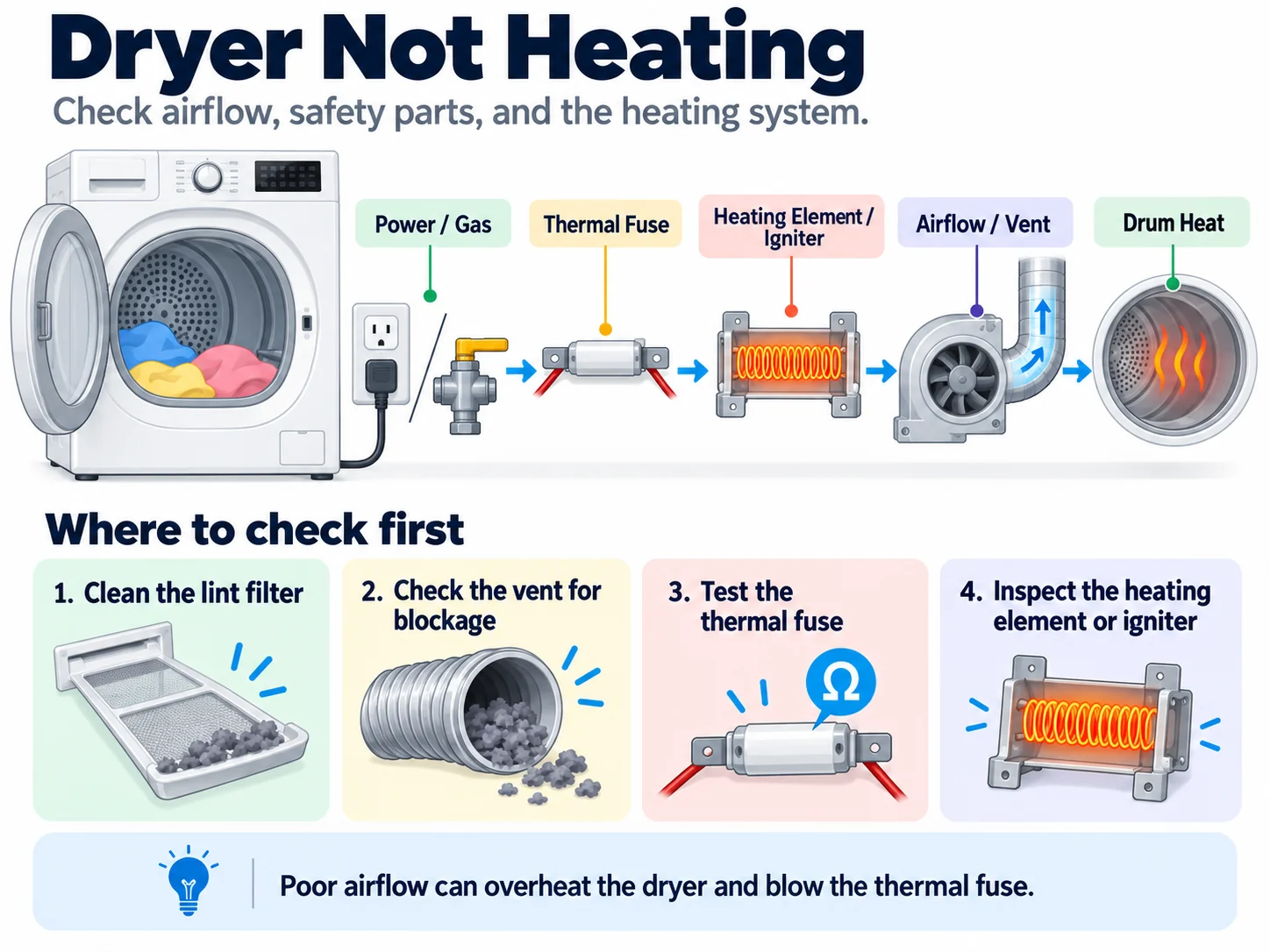
Most Likely Causes
| Cause | What You May Notice | Difficulty |
|---|---|---|
| Restricted vent or lint buildup | Long cycles, hot cabinet, weak flow at the outside hood; may contribute to overheating | Easy |
| Thermal fuse/cutoff or high-limit safety fault | Behavior varies by model: some safety devices stop heat, others stop the dryer entirely | Moderate |
| Failed heating element | Electric dryer, no heat at all, no warning signs beforehand | Moderate |
| One tripped breaker leg | Drum turns, lights and controls work, but no heat at all | Easy |
| Gas ignition or valve fault | Gas dryer, you may hear the igniter click or glow without the burner lighting | Technician recommended |
| Failed cycling thermostat | Heat is weak, or comes on briefly and never returns | Technician recommended |
1. Restricted Vent and Lint Buildup
This is the first thing to rule out, and the reason is mechanical rather than electrical. A dryer works by pulling room air across a heater, through the drum, and out the vent. When the duct is partly blocked, that hot air has nowhere to go, so heat builds up inside the cabinet instead of leaving with the moisture.
Dryers use thermostats and thermal safety devices to limit overheating, but their wiring differs by model. A restricted vent most commonly shows up as long drying times, excess cabinet heat or a vent warning; on some designs overheating can also open a one-time safety device.
How to check: inspect the transition duct for crushing, make sure the outdoor hood opens while the dryer runs, and clean the full vent path if airflow is weak. Do not run a gas dryer with the exhaust disconnected — combustion exhaust must be vented outdoors. If you have an electric dryer, use a disconnected-vent test only when the manufacturer explicitly recommends it for that model.
What it means: if the vent was blocked, clearing it is necessary but may not be sufficient. If a fuse already opened, the dryer will stay cold until that part is replaced — and replacing it without clearing the duct just leads to the same failure again.
Worth knowing: lint is highly flammable, and restricted dryer vents are a recognized cause of house fires. Clearing the duct is genuinely worth doing on a schedule, not just when something breaks.
2. Blown Thermal Fuse
Many dryers use one-time thermal fuses or cutoffs, but what they disable depends on the circuit design. On some models an open safety device stops heat; on others it prevents the motor from running at all. That is why the model’s wiring diagram matters before treating a fuse as the explanation for a dryer that still tumbles.
How to check safely: unplug the dryer, or switch off its breaker, before removing any panel. Testing a thermal fuse requires a multimeter set to continuity. If you are not comfortable identifying the part and confirming the power is off, this is a reasonable place to stop and call a technician.
What to do next: if a thermal safety device has opened, do not just replace it and walk away. Check the venting and other causes of overheating specified for that model before putting the dryer back into service.
3. Failed Heating Element (Electric Dryers)
The heating element is a coil of resistance wire inside a housing. When the coil breaks, current stops flowing and the dryer blows room-temperature air through the drum for the entire cycle.
What you may notice: no gradual decline, no long cycles beforehand, just cold air. Unlike a vent restriction, a failed element usually gives no warning.
How to check: with the dryer unplugged, the element can be tested for continuity. A broken coil sometimes shows a visible gap, but not always, so a visual check alone is not conclusive.
What it means: elements are consumable parts and do fail with age. Replacing one is a common repair, but it involves removing panels and disconnecting wiring, so it belongs to a technician unless you are confident working inside appliances with the power disconnected.
4. One Half of the 240-Volt Supply Is Missing
Electric dryers use a 240-volt circuit fed by a double breaker. The motor, drum light and control panel typically run on 120 volts, but the heating element needs the full 240.
That split explains a symptom people find confusing: everything looks alive, the drum spins, the display works, and yet there is no heat at all. Only half the supply is reaching the dryer.
How to check: at the panel, switch the dryer breaker firmly to the full off position, then back on. Breaker handles and trip indicators vary, so a full off/on reset is more reliable than judging by handle position alone. If it trips again immediately, stop and call an electrician.
What it means: this costs nothing to test and rules out a whole category of expensive assumptions. Do it before ordering parts.
5. Gas Ignition or Valve Problems (Gas Dryers)
A gas dryer’s burner system uses an igniter plus flame-sensing and gas-valve components. A failure anywhere in that sequence can leave the drum turning with little or no heat.
What you may notice: put your ear near the dryer early in the cycle. A repeated click or a burner that glows but never produces a flame suggests ignition rather than airflow.
What to do next: gas components are not a homeowner repair. Do not attempt to test the gas valve, bypass the flame sensor or adjust anything in the gas train. Confirm the supply valve is open and that other gas appliances in the house work, then call a qualified technician.
What Your Symptoms Mean
The exact pattern tells you a lot. Match yours to the closest description:
- Tumbles normally but never gets warm at all.Points at a thermal fuse, heating element, or a lost breaker leg. On a gas dryer, ignition.
- Gets warm but clothes are still damp after a full cycle.This is usually airflow rather than heat. The heater works; the moisture cannot escape. See our guide on a dryer that takes too long to dry.
- Heats at first, then repeatedly loses heat too early.Restricted airflow, a high-limit thermostat problem, sensing/control trouble or a gas-ignition issue can all cause cycling complaints. A one-time thermal cutoff does not reset itself during the cycle.
- Heats on some cycles but not others.Usually normal. Compare against a standard Cottons or Normal cycle before treating it as a fault.
- No heat and the dryer is also very hot to the touch outside.Stop using it and clear the vent. Heat is staying in the cabinet instead of leaving.
When to Call a Technician
Some of this is genuinely worth doing yourself, and some is not.
Handle yourself: cleaning the lint filter, inspecting/cleaning the vent path, resetting a tripped breaker once, checking the cycle setting, and confirming the gas shutoff valve is open on a gas model.
Call a qualified technician when: the dryer is gas and the burner will not light, a breaker trips repeatedly, you would need to test or replace internal electrical parts, the dryer has a burning smell, or you have cleared the vent and it still runs cold.
There is no shame in the second list. Parts are inexpensive; a misdiagnosis that damages the control board is not.
Brand-specific guides
The checks above apply to any dryer. These guides cover the same problem on specific brands.
Sources