Dryer Won't Start: How to Narrow It Down Fast
There is a useful split here. A dryer with no lights at all and a dryer that lights up but will not turn are two different problems, and separating them takes about ten seconds.
Quick answer
A dryer that is completely dead usually has a power problem: a tripped breaker, a partly seated plug, or on some models a blown thermal fuse. A dryer with lights and a working display but no movement points instead at the door switch, the start switch, or a motor that has failed. The clearest clue is whether the control panel lights up at all, so check that first.
Narrow down the cause
Answer a few questions about what your dryer is actually doing. It takes about a minute and nothing is saved.
What is your dryer doing?
Loading the questions…
The questions could not be loaded. The written guide below covers the same ground.
Start With These Quick Checks
- Does the control panel light up? This one answer splits the problem in half. No lights means no power reaching the dryer. Lights but no movement means power is fine and something downstream is stopping it.
- Push the door firmly shut and listen for the latch. Dryers will not run with the door even slightly open, and a worn latch can look closed without engaging the switch.
- Check the breaker. Switch it fully off, then fully on. Electric dryers use a double breaker, and a half-tripped breaker often does not look tripped.
- Check the plug at the outlet. Dryers vibrate, and a heavy cord can work its way partly out over time.
- Hold the start button for a full second or two. Many machines need a deliberate press rather than a tap.
- Check for a child lock or control lock. It is usually a padlock icon on the panel, often activated by holding one button for a few seconds.
- Listen carefully when you press start. A hum or a click with no movement is a very different clue from complete silence.
Quick Start-Up Flowchart
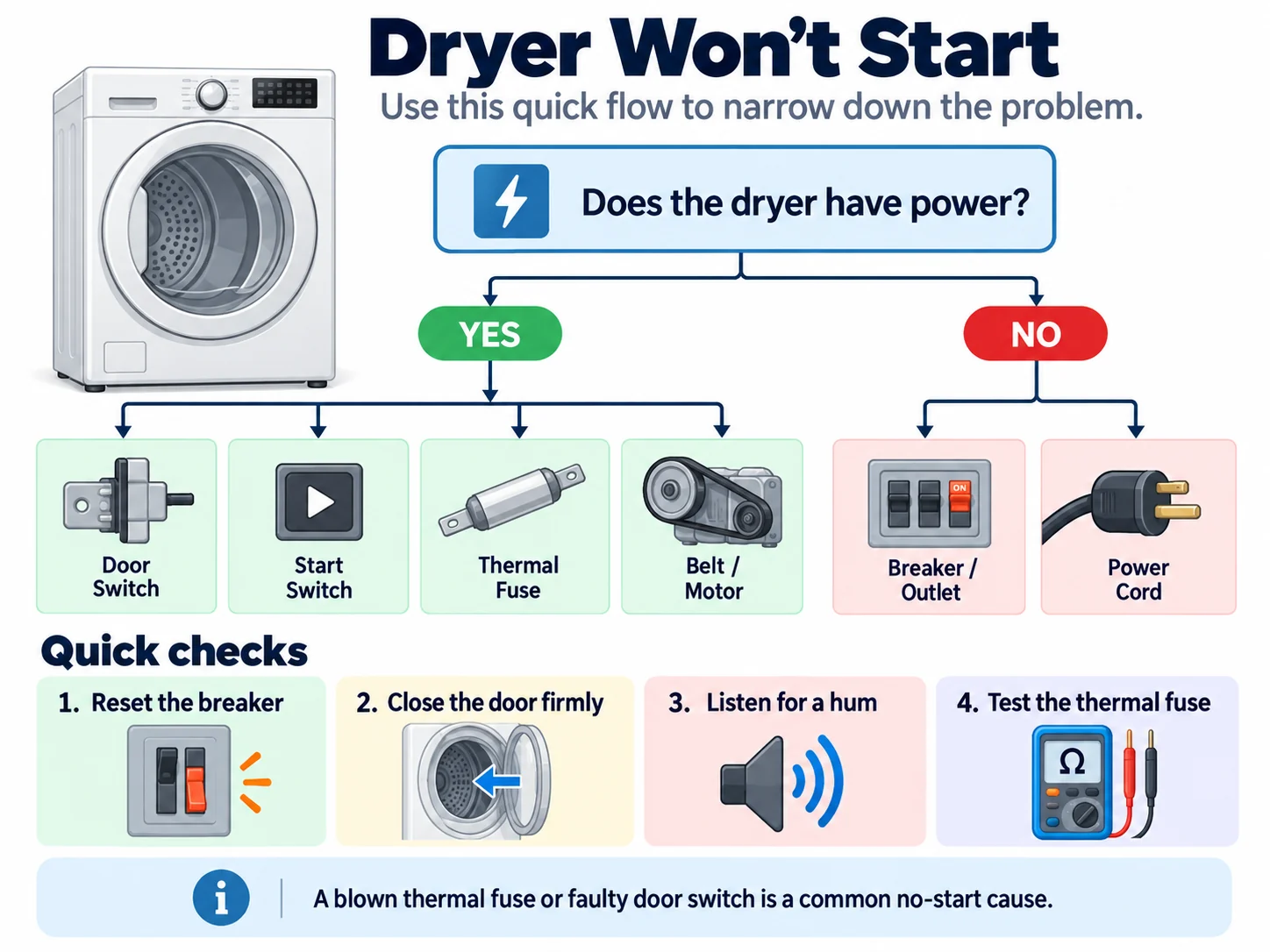
Most Likely Causes
| Cause | What You May Notice | Difficulty |
|---|---|---|
| Tripped breaker or unplugged cord | No lights, no sound, no response at all | Easy |
| Control lock enabled | Panel lights up but ignores buttons, lock icon showing | Easy |
| Door not latching | Panel works, nothing happens on start, door feels loose | Easy |
| Failed door switch | Door closes properly but the dryer still will not start | Moderate |
| Blown thermal fuse | Completely dead on models where the fuse feeds the motor | Moderate |
| Failed start switch | Panel works, no response or only a click when pressing start | Technician recommended |
| Seized or failed motor | Humming without turning, or a burning smell | Technician recommended |
1. No Power Reaching the Dryer
If nothing lights up and nothing makes a sound, treat this as an electrical supply problem before anything else.
How to check: go to the breaker panel. An electric dryer runs on a double breaker; move it firmly to off and back to on. Then confirm the cord is fully seated at the wall. If other things on the same circuit also stopped working, the problem is the circuit, not the dryer.
What it means: a breaker that trips again straight away is telling you something is wrong. Do not keep resetting it. That is an electrician’s job.
2. The Door Switch
Every dryer has a switch that proves the door is shut. It is a safety interlock, and without it closing, the machine will not run.
What you may notice: the panel lights normally and accepts your cycle selection, but pressing start does nothing at all. Sometimes pressing the door harder, or lifting it slightly while pushing it closed, makes the dryer work — that is a strong sign the switch or the latch is worn.
How to check safely: open and close the door and listen for a distinct click from the switch. Compare against how it used to sound. Do not tape the door shut or wedge the switch closed to “test” it; the interlock exists to stop the drum turning while someone is reaching inside.
What to do next: worn door switches and latches are a common, inexpensive repair, but replacing one means opening the cabinet with the dryer unplugged.
3. Blown Thermal Fuse
On many dryers the thermal fuse sits in the circuit that feeds the motor. When it opens, the machine goes completely dead, which is easy to mistake for a power problem.
What you may notice: the dryer was working normally, possibly running long or hot, and then stopped entirely with no warning. Breaker and outlet check out fine.
How to check safely: unplug the dryer before removing any panel. Confirming a thermal fuse requires a multimeter set to continuity.
What it means: as with a no-heat fault, the fuse is a symptom. It opened because the dryer overheated, and the usual reason is a blocked vent. Clear the duct before running the dryer again, or the replacement will fail too.
4. Start Switch and Controls
If the panel lights up, the door latches properly, and the breaker is fine, the start switch itself or the control board is the next suspect.
What you may notice: a single click when pressing start and nothing more, or no response from that one button while everything else on the panel works.
What to do next: this is where homeowner diagnosis reasonably stops. Control boards are expensive, and replacing one on a guess is a costly mistake. A technician can test the switch before anyone buys a board.
5. Motor Problems
A dryer that hums but does not turn is trying to start and failing.
What you may notice: a low hum for a few seconds, then silence or a click as a thermal overload cuts in. Sometimes the drum will turn if you help it by hand, which suggests a start capacitor or a seized component rather than a dead motor.
Important: if you smell burning, stop and unplug the dryer. Do not keep pressing start to see if it will catch.
What Your Symptoms Mean
- No lights, no sound, nothing.Power supply or thermal fuse.
- Panel lights up, start does nothing at all.Door switch or start switch.
- Panel lights up, one click on start, no movement.Start switch, motor or motor relay.
- Humming with no rotation.Motor or a mechanical obstruction.
- Starts, runs a few seconds, then stops.Often a motor overload cutting out, or a load jammed against the drum.
- Works when the door is pressed hard.Door latch or door switch.
When to Call a Technician
Do yourself: the breaker, the plug, the door latch, the control lock, and testing with a smaller load.
Call a technician when the dryer hums without turning, when you smell burning, when the breaker trips repeatedly, or when everything checks out and it still refuses to start. Those cases involve testing internal components with the power disconnected, and a wrong guess on a control board is an expensive way to learn.