Dishwasher Not Cleaning: Read the Pattern on the Dishes
Several different faults can leave dishes dirty. The pattern on the load — which rack is affected, whether the residue is greasy or gritty, and what happened to the detergent — helps separate them.
Quick answer
Before changing anything, look at the pattern. Gritty redeposited soil can point to a dirty or mis-seated filter; one rack consistently dirtier than the other can point to spray-arm, feed-tube or diverter trouble; and detergent left in the cup can come from a blocked dispenser, weak spray, low inlet temperature or an interrupted cycle. A greasy film is also consistent with water that was cooler than the dishwasher or detergent manufacturer recommends.
Narrow down the cause
Answer a few questions about what your dishwasher is actually doing. It takes about a minute and nothing is saved.
What is your dishwasher doing?
Loading the questions…
The questions could not be loaded. The written guide below covers the same ground.
Start With These Quick Checks
These checks usually separate a loading or maintenance issue from a temperature, fill or circulation problem before you touch anything mechanical.
- Run the hot faucet at the nearest sink until the water is hot, then start the dishwasher. Manufacturers commonly recommend hot incoming water — often around 120°F (49°C) — for best performance. Purging the cold water from the branch line gives the machine a warmer first fill and reduces how much internal heating it has to do.
- Look at what is left on the dishes. Gritty specks, greasy film and chalky white haze are three different faults. Note which one you have before reading further.
- Check the detergent cup after the cycle. Detergent left behind can mean the dispenser was blocked, spray did not reach the cup, the water was too cool, or the cycle did not complete. It is a useful clue, not a single diagnosis.
- Spin both spray arms with one finger. They should turn freely through a full circle without catching. A handle poking down through the upper rack is enough to stop one.
- Inspect the spray-arm holes. If your manual shows the arm as user-removable, take it off as directed and look through the holes for seeds, labels or other debris. Do not force a spray arm that is not designed for tool-free removal.
- If your model has a user-removable filter, remove and clean it as the manual shows. Some machines also have a flat screen or secondary filter surface that needs cleaning; other designs use a different filtration system.
- Listen partway through the cycle. A dishwasher that sounds unusually quiet during the main wash may not be circulating water at all.
Switch the dishwasher off at the wall or the breaker before reaching into the filter housing or the sump. Do not put your hand into the sump area to feel for debris — broken glass ends up there.
What Affects Cleaning Performance
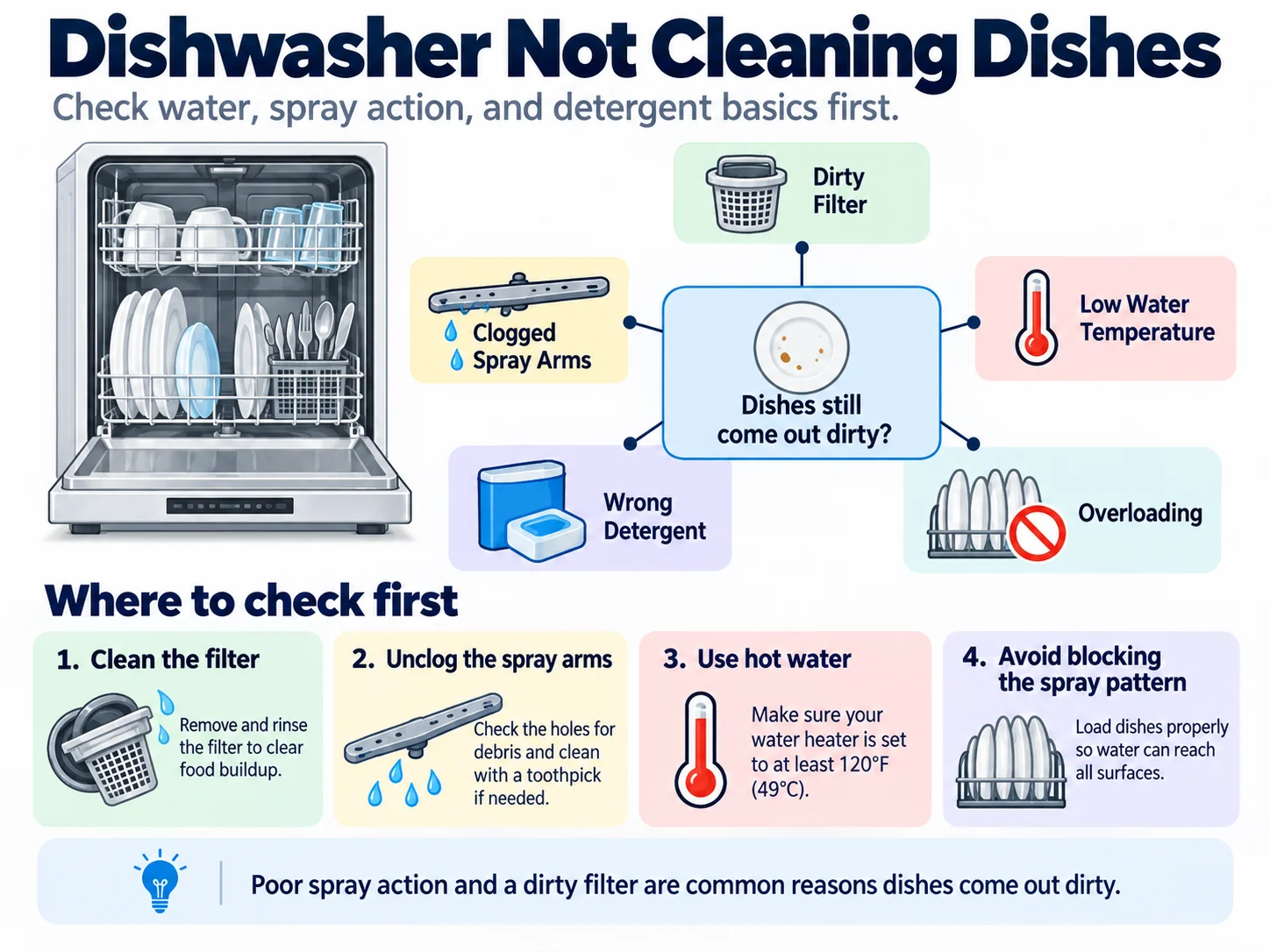
Most Likely Causes
| Cause | What You May Notice | Difficulty |
|---|---|---|
| Incoming water cooler than recommended | Greasy film or weaker cleaning, especially on short cycles; detergent may dissolve poorly | Easy |
| Blocked spray arm or obstructed spray path | One rack or area repeatedly cleans worse than the rest | Easy |
| Filter clogged or badly seated | Food comes back as gritty specks spread evenly over everything | Easy |
| Something blocking the spray path | One dirty patch behind a baking tray or tall pot | Easy |
| Hard water scale | Chalky film that built up slowly over months, plus weaker cleaning | Easy |
| Low fill level | Cycle sounds quiet, upper rack barely wet, lower rack acceptable | Technician recommended |
| Wash pump, diverter or feed-path fault | One rack stays consistently weak after loading and spray-arm checks | Technician recommended |
1. Water That Never Got Hot
Dishwasher detergent and wash programs are designed around a target water-temperature range. If the incoming water is much cooler than the manufacturer recommends, grease removal and detergent performance can suffer, and short cycles may have less time to recover the temperature.
The first fill can be cooler when cold water has been sitting in the branch line. Many dishwashers add heat internally, but the amount and timing vary by model.
How to check: run the hot faucet at the nearest sink until it is hot, then start the dishwasher immediately. Compare that load against a normal one. Also try a longer or heavier cycle rather than the quick one.
What it means: if pre-running the hot faucet makes a repeatable difference, inlet temperature is probably contributing. Check the dishwasher manual and the water-heater setting before assuming a failed part.
2. Spray Arm Holes Blocked From the Inside
Spray arms do not wash dishes by flooding them. Each hole produces a jet, and the arm spins because those jets are angled. Block a few holes and you lose both the jets and some of the spin.
What you may notice: one rack or area repeatedly cleans worse even when the load changes. That pattern can come from blocked spray holes, an obstructed feed path or something consistently interfering with arm rotation.
How to check: first spin the arm by hand with the dishwasher off. If the owner’s manual identifies it as user-removable, remove it as directed, hold it to the light and rinse debris from the spray holes. Designs differ, so do not pry or force the retaining hardware.
What it means: clearing blocked spray holes can restore wash coverage without replacing a part. Recheck that the arm spins freely after it is reinstalled.
3. The Filter, and the Screen Next to It
Many dishwashers recirculate wash water through a filter system. A clogged, damaged or incorrectly seated filter can reduce flow and allow more soil to remain in circulation.
What you may notice: fine gritty specks or redeposited soil spread across several parts of the load, including surfaces that were not heavily soiled to begin with.
How to check: if your model has a user-removable filter, remove it as the manual shows, rinse it under the faucet with a soft brush, and inspect any accessible mesh screen around it. Reinstall and lock it exactly as instructed; an incorrectly seated filter can hurt wash performance.
What it means: if the next comparable load improves substantially, filter maintenance was at least part of the problem and no part replacement may be needed.
4. Loading That Blocks the Spray Path
Water travels in straight lines from the arms. Anything large and flat between an arm and a dish casts a shadow, and nothing in that shadow gets washed.
What you may notice: one defined dirty area rather than general poor cleaning, usually behind a baking sheet, a cutting board, or a large pot placed face down in the lower rack.
How to check: run one deliberately conservative load. Nothing oversized, nothing laid flat across the lower rack, bowls angled so water can reach inside and drain back out, and no tall handles poking through to catch the upper arm.
What it means: if that load comes out clean, loading was at least part of the complaint. Baking sheets belong along the outer edges of the lower rack, standing on end, not across the middle.
5. Hard Water
In hard-water areas, dissolved calcium and magnesium leave a chalky film on glassware and gradually scale up the inside of the machine. Water hardness varies enormously across the United States, and it is a plumbing characteristic rather than an appliance fault.
What you may notice: the change was gradual over months, not sudden. Glasses look cloudy, and the cloudiness does not wipe off dry but does clear if you soak the glass in white vinegar for a few minutes.
How to check: on one affected glass outside the dishwasher, see whether a little white vinegar removes the haze. Mineral film often responds; permanent etching does not. For scale inside the dishwasher, use a cleaner or descaling method approved for your model.
What it means: hard water can reduce wash performance and leave deposits on dishes and internal parts. Use rinse aid and follow the detergent and water-hardness guidance in the owner’s manual rather than simply adding more detergent.
6. Low Fill or a Circulation Fault
If the machine is not taking in enough water, or not moving what it takes in, every check above comes back clean and the dishes stay dirty anyway.
What you may notice: the cycle sounds noticeably quieter than it used to during the main wash. Often the upper rack is barely damp while the lower rack is merely acceptable. If the machine is also leaving standing water at the end, read our guide on a dishwasher that will not drain first, because a drain fault changes the picture completely.
How to check: this is the end of what is reasonable to do yourself. Confirm the supply valve under the sink is fully open and that the inlet hose is not kinked behind the machine, then stop.
What it means: inlet valves, wash pumps and diverters are not homeowner repairs. They involve line voltage next to standing water.
What Your Symptoms Mean
Match the closest description. Each line leads somewhere different.
- Gritty specks appear across several parts of the load.Inspect the user-serviceable filter and spray system first; redeposited soil can also be influenced by loading and drainage.
- Greasy soil remains across the load, especially after short cycles.Check incoming-water temperature, cycle choice, detergent and circulation rather than assuming one cause.
- Detergent is still in the cup at the end.Check for a blocked dispenser, weak spray, low inlet temperature or an interrupted cycle before blaming the dispenser mechanism.
- Top rack dirty, bottom rack fine.Check the upper spray arm and feed path first; a diverter or circulation problem can produce a similar pattern.
- Bottom rack dirty, top rack fine.Check the lower spray arm and anything blocking its spray path.
- The same rack or area repeatedly cleans poorly.Check spray-arm movement, blocked jets, loading obstructions and the feed path to that rack.
- Chalky white haze that clears after soaking in vinegar.Hard water, not a fault.
- Cloudy glass that does not clear with a gentle vinegar test.Permanent etching is possible. Very soft water, excess detergent, long hot cycles and the glassware itself can contribute; etching cannot be reversed.
- The machine sounds quiet and nothing is really wet.Fill level or circulation. This is the one to stop and call about.
When to Call a Technician
Do yourself: the hot-water purge test, cleaning the filter and its screen, clearing spray arm holes, loading changes, descaling, checking the supply valve and the inlet hose.
Call a qualified technician when the dishes stay dirty after all of the above, when the wash sounds abnormally quiet or the tub is barely wet, when the detergent cup does not open on a cycle you watched, or when cleaning got worse at the same time as a leak or a new noise.
If these checks do not change the result, model-specific service information is more useful than guessing at an inlet valve, wash pump, diverter or control board.
Sources